
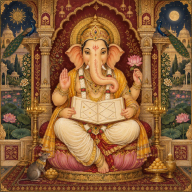

Gauri Yoga
Gauri Yoga follows a lordship chain from the tenth lord into its Navāṁśa sign. Traditional themes include charity and recognition. A D1 diagram alone cannot establish the full combination; the D9 relationship also matters.
Aries Lagna · Mars and Jupiter in D1 Capricorn
Schematic D1 example. La = Lagna · Ma = Mars · Ju = Jupiter · Sa = Saturn
How Gauri Yoga forms
Find the tenth lord in the D1 chart, then identify its Navamsa sign. The lord of that D9 sign must join the ascendant lord in the tenth house of D1.
The conjunction belongs in the birth chart, while the intermediate sign comes from Navamsa. Keeping those two charts distinct prevents the rule from being reduced to any conjunction of the ascendant and tenth lords.
Aries rises, making Saturn the tenth lord. Saturn at 18° Aquarius falls in Pisces Navamsa, whose lord is Jupiter. Jupiter and Mars, the ascendant lord, are placed together in Capricorn in D1's tenth house. The degree and D9 assumption are stated alongside the two D1 chart styles.

Charity and community recognition
The traditional account links Gauri with charitable activity and being praised by others. These themes describe a public response to conduct in the source's cultural setting.
The chart combination does not establish whether someone is generous or widely admired. It supplies the structure for a traditional interpretation.

Religious life and material resources
Religious rites and land appear in the description. They place the yoga within a world where ritual participation and property were prominent signs of social standing.
The source also makes claims about family lineage and descendants. Those are not judgments to apply to a reader or their family, and they are not needed to explain this D1–D9 relationship.
Traditional interpretations are not guaranteed outcomes; consider the whole birth chart.
Does your chart have Gauri Yoga?

Use Mạghā Astro AI to find out. Explore the yogas in your birth chart and the planetary combinations behind them.
Check your chart