

Kālachakra Daśā follows sign periods
Kālachakra Daśā is a sign-period system associated with the Moon's birth nakṣatra and pāda. Its name means “wheel of time”. Mạghā offers an experimental reader with dated periods; the worked example uses the Nila Raman chart.

Start with the Moon’s nakṣatra and pāda
A nakṣatra has four pādas, or quarters. Kālachakra uses this finer division of the Moon’s position, so the recorded birth time and calculation settings matter when you compare charts or period tables.
Keep the birth date, time, place and ayanāṁśa together with any saved result. Nila’s example uses 14 October 1994, 06:30 IST in Bengaluru, with Lahiri ayanāṁśa. The dates here belong to that prepared chart; changing a setting in your own chart calls for reading its own result.
Nila Raman. Historical prepared output; UTC calendar dates. Bar widths use saved duration in days. No active-period claim.
Birth marker · 14 Oct 1994
- 01Pisces20 Apr 1994 →
20 Apr 2001 - 02Aquarius20 Apr 2001 →
20 Apr 2017 - 03Capricorn20 Apr 2017 →
20 Apr 2026 - 04Sagittarius20 Apr 2026 →
21 Apr 2047
Widths follow the saved duration in days. Dates are shown in UTC. Historical prepared output; no active-period claim.
The saved example moves through unequal sign periods
The first four periods in Nila’s saved data are Pisces, Aquarius, Capricorn and Sagittarius. They last 7, 16, 9 and 21 years respectively. Pisces begins in April 1994, before her October birth; Aquarius follows in April 2001, Capricorn in April 2017 and Sagittarius in April 2026.
The bars use the saved durations rather than equal-sized boxes. They show part of one prepared sequence, not a universal sign order or a new calculation for a visitor. Calendar dates are the saved output’s UTC dates.

Read the sign period alongside the birth chart
A period table answers which interval you are examining. Interpreting that interval also calls for the sign’s place in the birth chart and the relationships you use in your chosen astrological tradition. A date range alone does not establish that an event will happen.
The diagram uses the saved data’s sign names. The real preview retains the app’s displayed labels, including planet labels in parts of this reader. Compare the dates and the selected system as well as the label when following the example.
Nila Raman. Historical prepared output; UTC calendar dates. Bar widths use saved duration in days. No active-period claim.
- 01Pisces20 Apr 1994 →
19 Sept 1994 - 02Aquarius19 Sept 1994 →
31 Aug 1995 - 03Capricorn31 Aug 1995 →
13 Mar 1996 - 04Sagittarius13 Mar 1996 →
11 Jun 1997 - 05Scorpio11 Jun 1997 →
28 Sept 1997 - 06Libra28 Sept 1997 →
11 Apr 1998 - 07Virgo11 Apr 1998 →
24 Mar 1999 - 08Cancer24 Mar 1999 →
22 Aug 1999 - 09Leo22 Aug 1999 →
26 Mar 2000 - 10Gemini26 Mar 2000 →
21 Jun 2000 - 11Taurus21 Jun 2000 →
15 Sept 2000 - 12Aries15 Sept 2000 →
20 Apr 2001
Widths follow the saved duration in days. Dates are shown in UTC. Historical prepared output; no active-period claim.
Open a period to inspect its smaller intervals
The first Pisces period in the saved example runs from 20 April 1994 to 20 April 2001. Its nine saved sub-periods divide that same interval into smaller dated spans. The diagram below keeps their own sign labels and relative lengths.
In the reader, an expandable period row lets you move from the broad interval to the sub-periods beneath it. The preview begins on the sample’s fixed reference date, 12 September 2026, so its active summary belongs to a later part of the sequence than this first-period diagram.
Choose Kālachakra Daśā
In the Daśā reader, choose Experimental → Kalachakra. Its heading identifies the system; period rows expand to show dated sub-periods.
The walkthrough uses the prepared chart. It accepts no birth details and calculates no personal result.
Note: Kālachakra is experimental. This guide does not certify a traditional interpretation or agreement with other programs.
Questions about Kālachakra Daśā
What is Kalachakra Dasha?
Kālachakra is a sign-period system associated with the Moon’s nakṣatra and pāda at birth. It follows sign periods rather than the familiar nine-planet sequence of Vimśottarī.
Why does the Moon’s pada matter?
A pāda is one quarter of a nakṣatra. Kālachakra distinguishes these quarters, so a Moon position close to a boundary deserves particular care when checking the recorded birth time and calculation settings.
Where is Kalachakra in Magha?
In a saved chart’s Daśā reader, open ⋯, choose Experimental, then Kalachakra. The website preview demonstrates that selection on Nila Raman’s chart.
Does this preview calculate my Kalachakra periods?
No. It opens an existing chart with saved periods and a fixed reference date. Open your own saved chart in the app to read its result.
Open Kālachakra Daśā on your saved chart
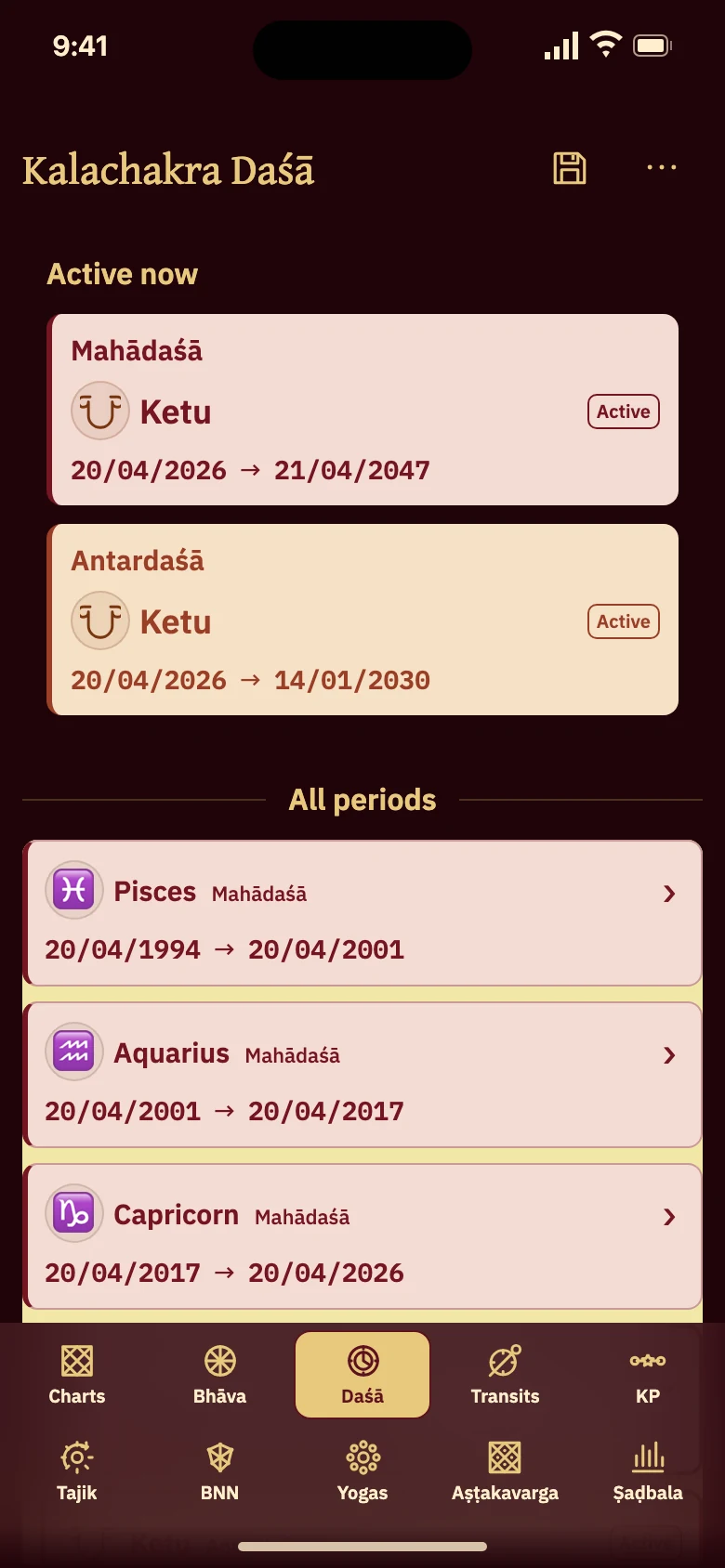
This walkthrough chooses Kalachakra on Nila Raman’s chart and shows the real saved reader. The sample is fixed on 12 September 2026; it does not calculate a personal result from visitor details.
Open your charts