


Maṇḍūka Daśā
Maṇḍūka, meaning frog, names a sign daśā that jumps between signs instead of following consecutive neighbours. Mạghā lists Mandooka under Rāśi and Other Daśās. Read both the sign order and each period's dated length.
Nila Raman’s chart. Libra, 12 years, 1994-10-14 to 2006-10-14; Capricorn, 1 year, 2006-10-14 to 2007-10-14; Aries, 3 years, 2007-10-14 to 2010-10-14; Cancer, 6 years, 2010-10-14 to 2016-10-13; Sagittarius, 10 years, 2016-10-13 to 2026-10-14; Pisces, 7 years, 2026-10-14 to 2033-10-14; Gemini, 4 years, 2033-10-14 to 2037-10-14; Virgo, 1 year, 2037-10-14 to 2038-10-14; Scorpio, 8 years, 2038-10-14 to 2046-10-14; Aquarius, 8 years, 2046-10-14 to 2054-10-14; Taurus, 5 years, 2054-10-14 to 2059-10-14; Leo, 1 year, 2059-10-14 to 2060-10-13. Dates are the saved fixture’s UTC calendar dates. The diagram uses saved sign display names and does not perform a new calculation.
Birth marker · 14 Oct 1994
- 01Libra14 Oct 1994 →
14 Oct 2006 - 02Capricorn14 Oct 2006 →
14 Oct 2007 - 03Aries14 Oct 2007 →
14 Oct 2010 - 04Cancer14 Oct 2010 →
13 Oct 2016 - 05Sagittarius13 Oct 2016 →
14 Oct 2026 - 06Pisces14 Oct 2026 →
14 Oct 2033 - 07Gemini14 Oct 2033 →
14 Oct 2037 - 08Virgo14 Oct 2037 →
14 Oct 2038 - 09Scorpio14 Oct 2038 →
14 Oct 2046 - 10Aquarius14 Oct 2046 →
14 Oct 2054 - 11Taurus14 Oct 2054 →
14 Oct 2059 - 12Leo14 Oct 2059 →
13 Oct 2060
Widths follow the saved duration in days. Dates are shown in UTC. Gold marks the current period.
Libra, Capricorn, Aries and Cancer begin this sample
Nila’s saved sequence opens with Libra for twelve years, Capricorn for one, Aries for three and Cancer for six. It then moves to Sagittarius, Pisces, Gemini and Virgo before continuing through the remaining signs. Read the labels in sequence rather than assuming that neighbouring periods belong to neighbouring signs.
The diagram preserves all twelve saved main periods, a 66-year span. Sagittarius is highlighted at the sample’s reference instant of 12 September 2026, within its October 2016 to October 2026 interval. These are recorded Mạghā sample values, not a fresh comparison with another school or program.

Follow the sequence before comparing dates
When studying Maṇḍūka, first write down the sign order. A comparison that checks only the first date can miss a different next sign. Then compare the duration of each main period and the smaller periods nested within it, using the same birth details and calculation context.
Treat the running sign as a way to organize chart study. Its houses, occupants and relationships need interpretation in the chart; the name of a period alone does not establish an event. Keep the selected method with your notes so that a later reading follows the same sequence.

Open Mandooka on a saved chart
In the Daśā view, open the options menu, choose Rāśi and Other Daśās, then Mandooka. The header identifies the selected system and the tree presents its prepared periods. Expand a main-period row to inspect the periods within it.
The preview uses the real bundled interface and Nila’s chart. The adjacent diagram labels signs from the saved fixture’s display names; the product capture keeps the app’s own labels and presentation. Neither changes the sample data to produce a different result.
Questions about Maṇḍūka Daśā
Why is it called the frog daśā?
The name Maṇḍūka refers to a jumping progression. In the saved example, the first four signs are Libra, Capricorn, Aries and Cancer, making that change of order easy to follow.
Does every period last the same number of years?
Not in this saved Mạghā example. Its first four lengths are twelve, one, three and six years. The diagram shows the actual stored lengths rather than equal decorative blocks.
Can I compare Maṇḍūka with Chara?
Yes. Keep the same chart and settings, identify the chosen system, and compare the sign order and dates separately. The two entries are distinct methods; matching one interval does not make their whole sequences interchangeable.
Explore Maṇḍūka Daśā on your chart
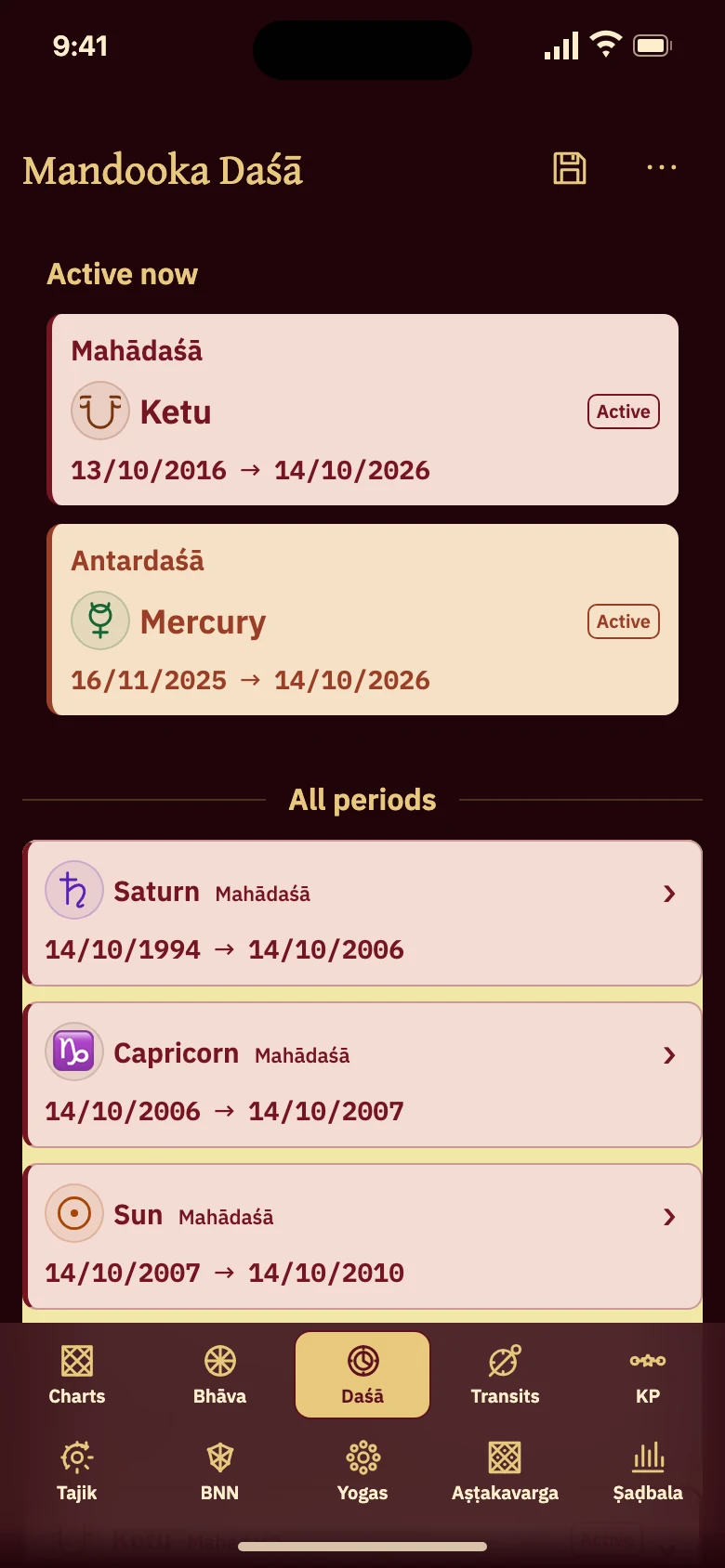
This genuine preview opens Mandooka on Nila Raman’s prepared chart. To read your own periods, open the intended saved chart in Mạghā and choose the same system.
Open Maṇḍūka Daśā in Mạghā