

Yoginī Daśā
Yoginī Daśā divides 36 years among eight planetary lords, with periods increasing from one to eight years and no Ketu period. Mạghā displays major periods and dated subdivisions under Yogini in the Graha Daśās group.
Bars use the saved duration in days: Moon 1 years, Sun 2 years, Jupiter 3 years, Mars 4 years, Mercury 5 years, Saturn 6 years, Venus 7 years, Rahu 8 years. The birth marker is 14 October 1994. This chart runs from 1994-09-18 to 2030-09-19.
Birth marker · 14 Oct 1994
- 01Moon18 Sept 1994 →
19 Sept 1995 - 02Sun19 Sept 1995 →
18 Sept 1997 - 03Jupiter18 Sept 1997 →
18 Sept 2000 - 04Mars18 Sept 2000 →
18 Sept 2004 - 05Mercury18 Sept 2004 →
18 Sept 2009 - 06Saturn18 Sept 2009 →
19 Sept 2015 - 07Venus19 Sept 2015 →
19 Sept 2022 - 08Rahu19 Sept 2022 →
19 Sept 2030
Widths follow the saved duration in days. Dates are shown in UTC. Gold marks the current period.
Follow the saved cycle from the Moon to Rāhu
Nila's saved Yoginī cycle starts with the Moon in September 1994, shortly before her October birth. The Sun follows in September 1995, then Jupiter, Mars, Mercury, Saturn and Venus. Rāhu is the final major period in this prepared cycle, from 19 September 2022 to 19 September 2030.
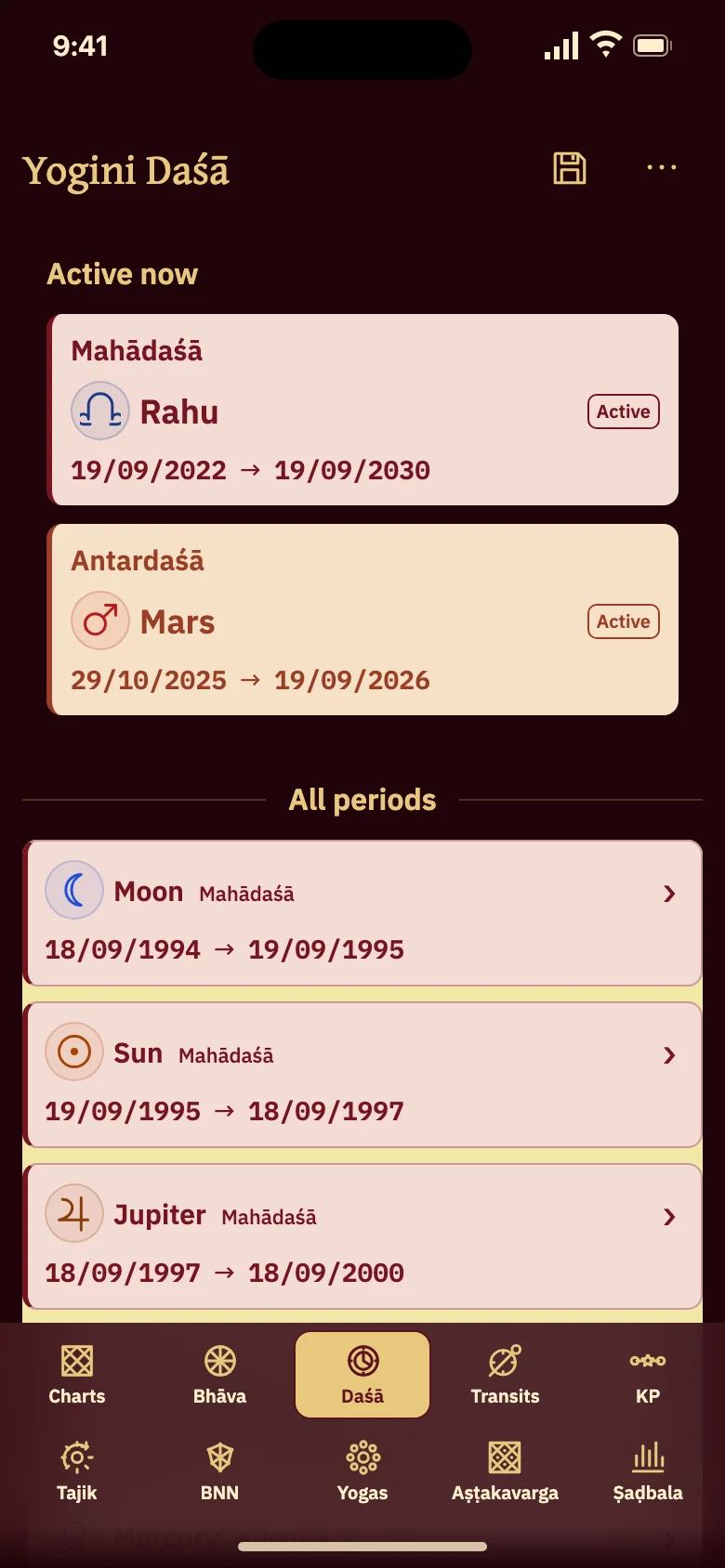
The demonstration is fixed on 12 September 2026. Rāhu is the major lord and Mars the antardaśā lord; the displayed Mars sub-period runs from 29 October 2025 to 19 September 2026. Its ending is close to the reference date, while the enclosing Rāhu period continues for several more years.
The diagram draws the saved periods in proportion to their duration in days and marks birth inside the opening Moon span. It contains the one recorded cycle, ending in September 2030, rather than inventing additional future sample periods.

Read the Yoginī names alongside the planetary labels
The Yoginī names map to planets: Maṅgalā–Moon, Piṅgalā–Sun, Dhānyā–Jupiter, Bhrāmarī–Mars, Bhadrikā–Mercury, Ulkā–Saturn, Siddhā–Venus and Saṅkaṭā–Rāhu. Mạghā labels period rows with planetary names. In the sample, Mars is an antardaśā inside Rāhu, not a separate four-year major period. Read the nested lords together with the natal chart; the labels identify spans rather than guaranteed events.
Choose Yogini and open the finer periods
Choose Yogini under Graha Daśās. The phone preview opens at Antardaśā with Rāhu/Mars current; display options extend through Pratyantardaśā and Sūkṣma. It contains one prepared Nila cycle at a fixed reference date, without calculating new visitor charts. For your own schedule, check birth inputs and calculation settings. Yoginī and Ṣaṭtriṁśa Sama remain separate methods despite sharing a 36-year total.
Questions about Yoginī Daśā
Why does the app show Rāhu instead of Saṅkaṭā?
The period rows use planetary names. Saṅkaṭā is the traditional Yoginī name associated with Rāhu, just as Maṅgalā is associated with the Moon. The saved sample's current major period is therefore labelled Rahu in the app. The guide uses Rāhu with its Sanskrit diacritic.
Is Ketu part of Yoginī Daśā?
No. The eight planetary lords are the Moon, Sun, Jupiter, Mars, Mercury, Saturn, Venus and Rāhu. Their one-to-eight-year allocations total thirty-six years. This differs from Vimśottarī's nine-lord, 120-year schedule, so the two should be read as distinct timing systems.
How do I read a major lord and a sub-period lord together?
Begin with the enclosing mahādaśā and then read its current antardaśā as a smaller span inside it. On the fixed sample date, Mars runs inside Rāhu. The dates beside the two rows show that relationship; Mars's shorter row ends in September 2026 while Rāhu continues to September 2030.
Can I compare Yoginī and Ṣaṭtriṁśa Sama?
Yes, by selecting each method separately on the same chart. Their shared total does not make the saved schedules interchangeable: Nila's Yoginī example opens with the Moon, while her Ṣaṭtriṁśa Sama example opens with Venus. Confirm the heading and keep each system's major and sub-period dates together.
Open your Yoginī Daśā periods
Read your own major periods and the dated sub-periods inside them. Yoginī Daśā is free for life, like every astrology feature in Mạghā.
Open your charts