


Pātyāyinī Daśā explores annual periods
Pātyāyinī Daśā divides an annual span into planetary periods for Tājika study. Mạghā offers Patyayini under Experimental, with periods and subdivisions for the selected annual year. The worked example uses a saved chart.
Nila Raman. Historical prepared output; UTC calendar dates. Bar widths use saved duration in days. No active-period claim.
Birth marker · 14 Oct 1994
- 01Sun14 Oct 1994 →
12 Nov 1994 - 02Moon12 Nov 1994 →
26 Dec 1994 - 03Mars26 Dec 1994 →
27 Jan 1995 - 04Mercury27 Jan 1995 →
9 Mar 1995 - 05Jupiter9 Mar 1995 →
25 Apr 1995 - 06Venus25 Apr 1995 →
19 Jun 1995 - 07Saturn19 Jun 1995 →
9 Aug 1995 - 08Rahu9 Aug 1995 →
15 Sept 1995 - 09Ketu15 Sept 1995 →
14 Oct 1995
Widths follow the saved duration in days. Dates are shown in UTC. Historical prepared output; no active-period claim.
The saved annual example starts with the Sun
In Nila’s saved year-one example, the Sun runs from 14 October to 12 November 1994. The Moon follows to 26 December, Mars to 27 January 1995 and Mercury to 9 March. The full diagram shows the nine saved major periods, sized by their durations in days.
These dates are a historical prepared example and use the output’s UTC calendar dates. They do not describe a visitor’s annual chart or establish that another implementation uses the same ordering or boundaries.

Keep the method and annual year together
Pātyāyinī and Mudda are both annual systems, but choosing one does not give it the other’s period dates. Read the selected system name, annual year and period boundaries together before drawing a comparison.
A dated interval gives structure to a reading; it is not a prediction by itself. Interpret it with the annual chart and the method you follow. This page demonstrates the available app output without presenting it as a certification of a classical calculation rule.

Open Patyayini from Experimental
Open a saved chart’s Daśā reader, select ⋯, choose Experimental, then Patyayini. The reader changes its system heading and period list. Its options include Annual year for the annual context.
The preview uses the real selector and the unchanged Nila’s chart. It is a demonstration of the reader, not a form for entering your own birth details.
Note: Mạghā marks Pātyāyinī experimental. Keep that status with any saved reading, and check the method and annual settings you intend to use before relying on its dates.
Questions about Pātyāyinī Daśā
What is Patyayini Dasha used for?
Pātyāyinī belongs to annual-chart work associated with the Tājika tradition. Its planetary periods provide dated intervals within an annual context.
How is Patyayini different from Mudda?
They are separate annual period systems. Select each by name and compare its own dates and annual year; a Mudda table cannot stand in for a Pātyāyinī result.
Why is Patyayini under Experimental?
That is the status and menu grouping currently exposed by Mạghā. This guide preserves that qualification and does not treat availability as a guarantee of classical agreement.
Open Pātyāyinī Daśā on your saved chart
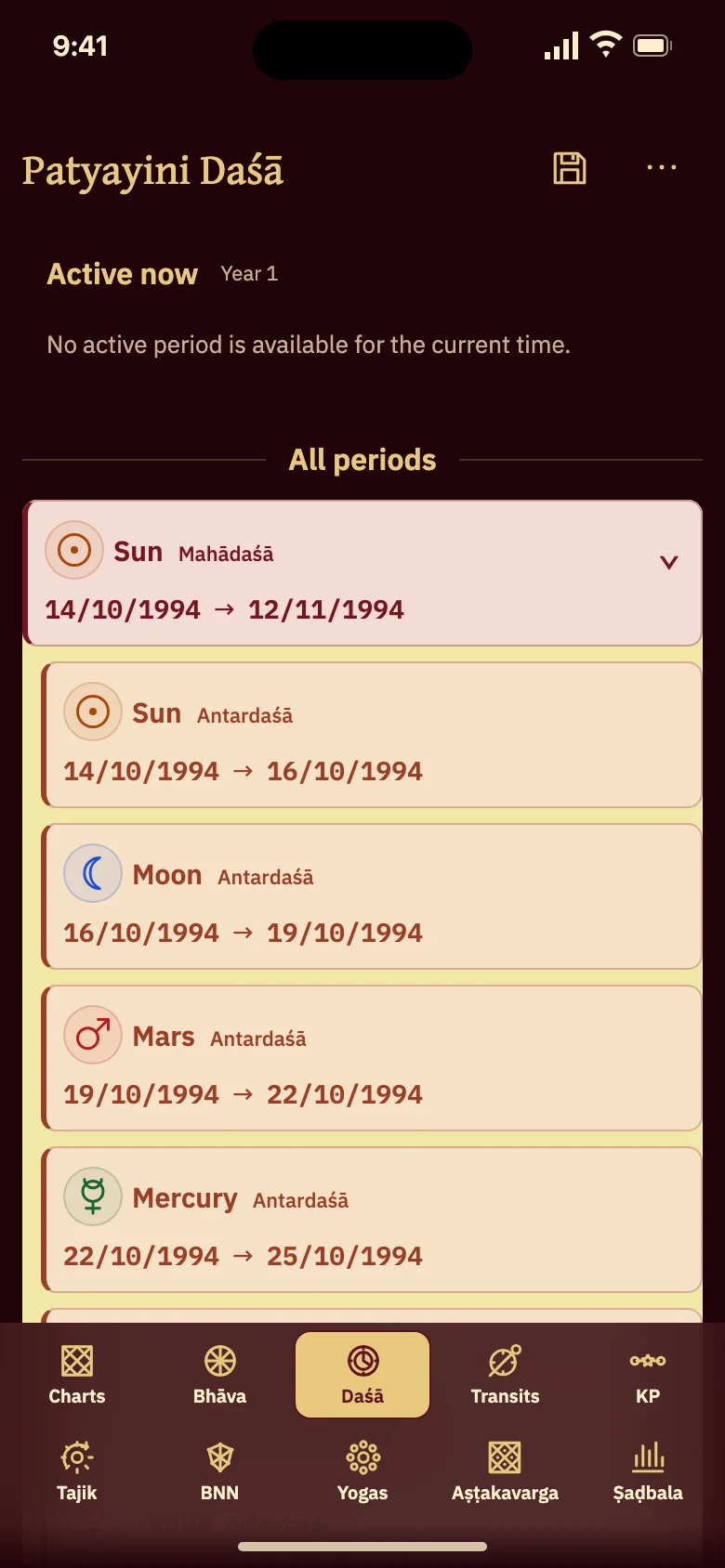
Explore Pātyāyinī on your chart. The Nila Raman demo opens its saved Year 1 periods and expands the first main period, Sun, from 14 October 1994.
Open your charts