


Kāla Daśā shows a time-based period option
Kāla Daśā, labelled Kaala in Mạghā's Experimental group, displays dated planetary periods. It is separate from Kālachakra. The worked timeline preserves Nila Raman’s chart's saved results and its fixed reference date.
Saved main periods for Nila Raman’s chart at 12 September 2026. All 9 main periods are shown with their recorded lengths. The birth marker and current highlight follow the saved fixture.
Birth marker · 14 Oct 1994
- 01Jupiter15 Dec 1993 →
15 Dec 2005 - 02Venus15 Dec 2005 →
15 Dec 2017 - 03Saturn15 Dec 2017 →
15 Dec 2029 - 04Rahu15 Dec 2029 →
15 Dec 2041 - 05Ketu15 Dec 2041 →
15 Dec 2053 - 06Sun15 Dec 2053 →
16 Dec 2065 - 07Moon16 Dec 2065 →
16 Dec 2077 - 08Mars16 Dec 2077 →
16 Dec 2089 - 09Mercury16 Dec 2089 →
17 Dec 2101
Widths follow the saved duration in days. Dates are shown in UTC. Gold marks the current period.
Nine equal bars describe the saved main periods
Nila’s saved Kāla list begins with Jupiter in December 1993, followed by Venus in December 2005 and Saturn in December 2017. Each of its nine main periods lasts twelve sidereal years. Saturn continues to December 2029 and contains the sample’s reference date.
Rāhu, Ketu, the Sun, the Moon, Mars and Mercury follow in the stored sequence. The diagram uses the recorded period lengths without deriving them from sunrise or sunset. Its birth marker shows why the first bar begins before Nila’s birth, and the highlight marks the main period at the fixed sample date.

Distinguish the method from the word for time
Kāla means time, but the name alone does not specify how a daśā’s years are assigned. The historical materials describe birth-time approaches to Kāla; this page does not use those descriptions to recalculate or relabel the app’s supplied result.
For study, first note the system selected in the picker, then read the dates it supplies. A side-by-side comparison with Vimśottarī is meaningful only when each list retains its own name, starting point and period lengths.
The chart remains necessary for interpretation. A twelve-year bar shows an interval in this saved sequence; it does not, by itself, predict what will happen during that interval. The preview is intended to make the period screen familiar.

Find Kaala under Experimental
From the Daśā card on a saved chart, open the options menu, choose Experimental and select Kaala. The phone view shows the active period summary and the dated rows. The preview follows those controls on the real bundled sample.
Experimental in Mạghā identifies this as a study option without a guarantee of parity with every reference method. The supplied sample includes sub-periods, even though the historical option metadata lists antardaśās as off by default. The walkthrough does not demonstrate a switch for that setting.
Note: The saved equal-period example is the app’s supplied Kāla result; it does not demonstrate a dawn, day, dusk or night calculation.
Questions about Kāla Daśā
Is Kāla Daśā the same as Kālachakra?
No. Kaala and Kalachakra are separate options in the app. This guide and its screenshots refer only to Kaala.
How long are the main periods shown here?
The saved Nila fixture supplies nine main periods of twelve years each. These are the lengths shown by this page’s timeline, rather than a new calculation from birth-time segments.
Does the preview show antardaśās?
The supplied sample includes a main-period and sub-period summary. The preview shows that real screen but does not demonstrate a separate control for turning antardaśās on or off.
Choose Kāla Daśā on your chart
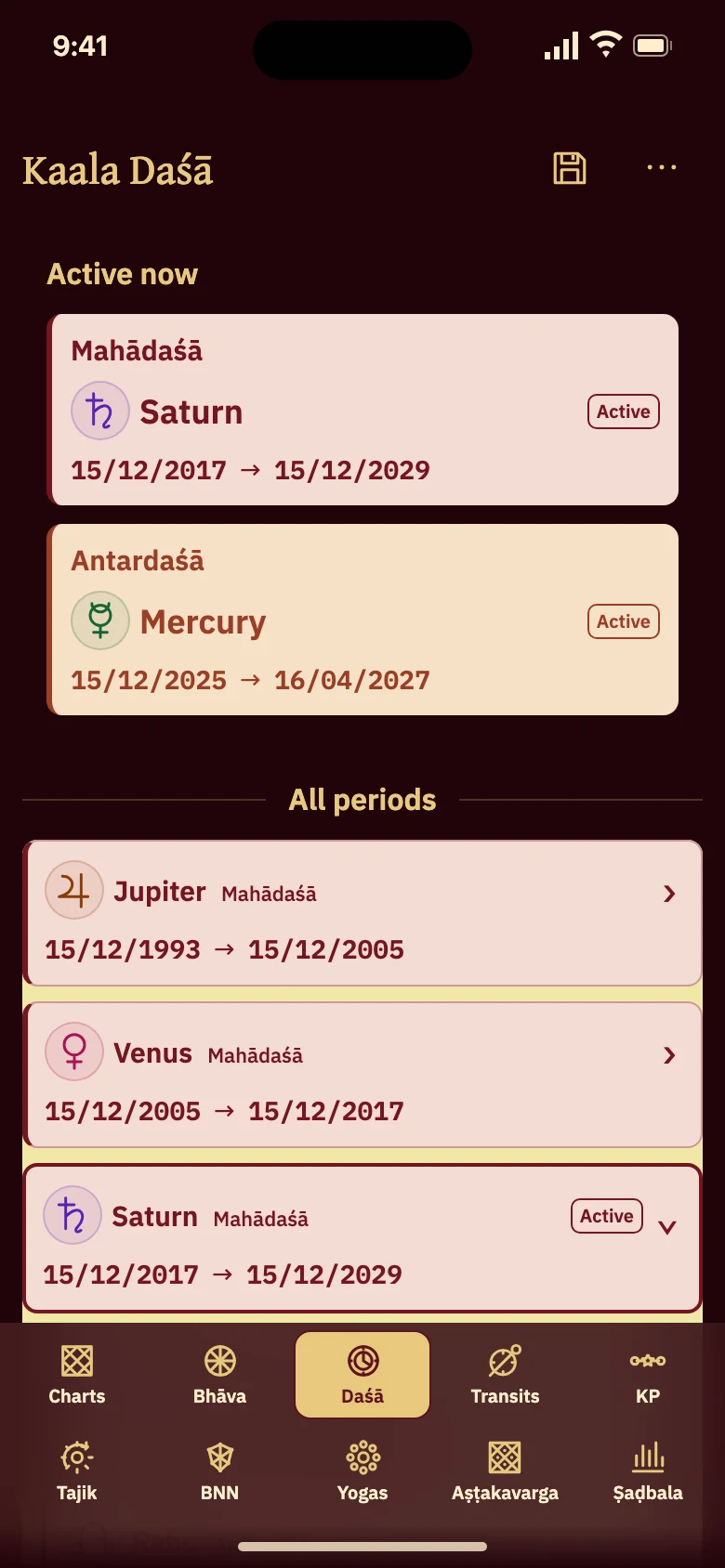
Open Kaala on a chart you save in Mạghā. Astrology features are free for life. This phone-layout preview, also used on desktop, selects the real system on Nila Raman’s chart at a fixed date.
Open your daśā periods