
Western points
Add up to 21 optional Western positions to Mạghā's natal ledger: minor bodies, nodes, Black Moon, angles, additional points and lots. They use Swiss Ephemeris and remain off until selected. Adding a row does not change the Vedic calculations.
The minor bodies are two centaurs and the first four asteroids found
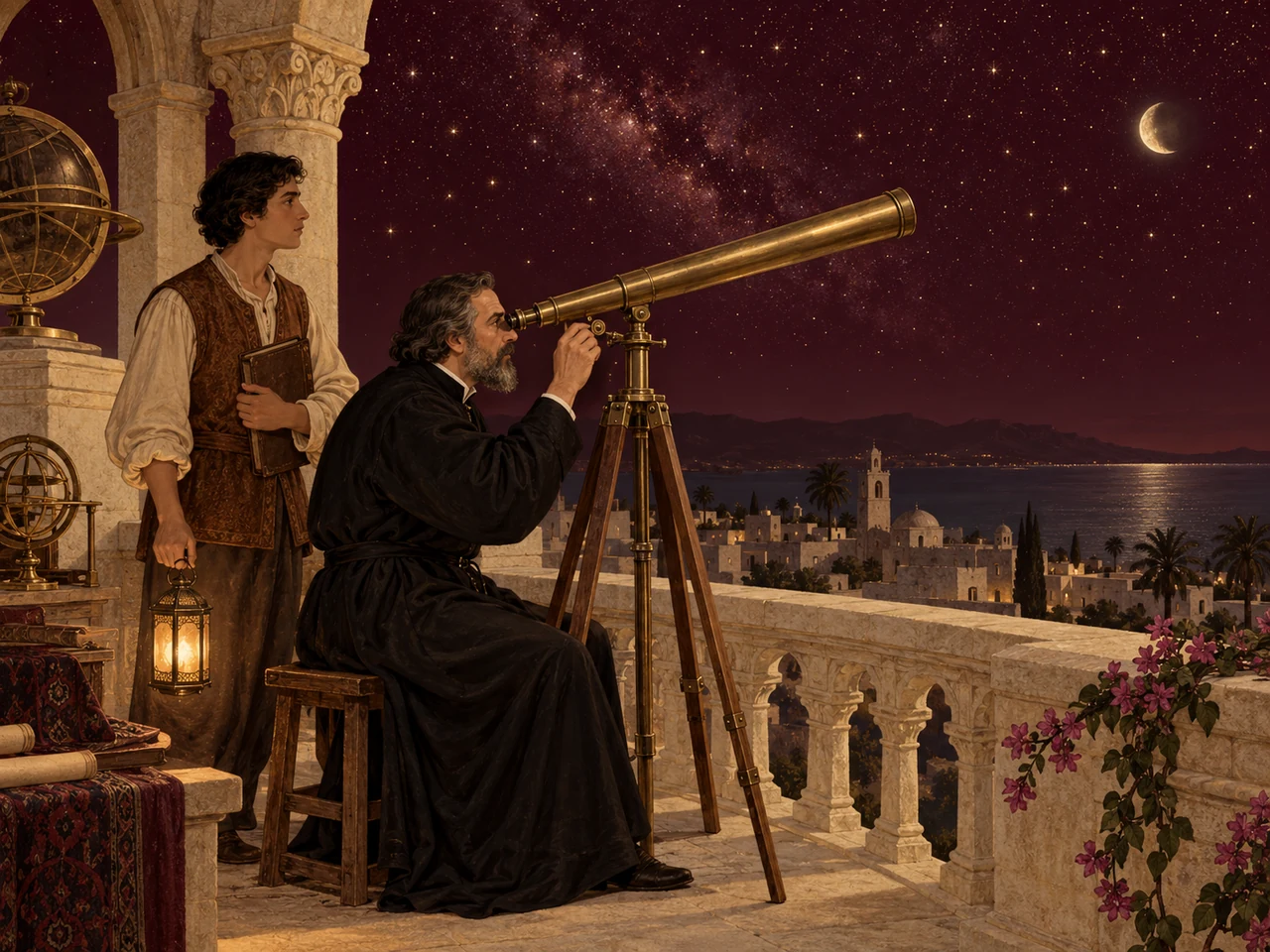
Giuseppe Piazzi found Ceres, the first asteroid, from Palermo on 1 January 1801. Heinrich Olbers found Pallas in 1802 and Vesta in 1807, and Karl Harding found Juno in 1804. The centaurs, small bodies that orbit among the giant planets, came much later: Charles Kowal recognised Chiron on 1 November 1977 in images taken at Palomar Observatory, and the Spacewatch survey at Kitt Peak found Pholus in January 1992.
Mạghā takes all six from the Swiss Ephemeris asteroid file, which covers births from about 1800 to 2400; outside that range their rows say the ephemeris does not provide them. Like planets, they show direct or retrograde motion. For Nila, Chiron is at 25°57′ Leo, Ceres at 14°03′ Cancer and Pallas, retrograde, at 29°09′ Aries.

Rāhu and Ketu are the mean nodes, and the true nodes wobble around them
The lunar nodes are the two points where the Moon's orbit crosses the ecliptic, the Sun's yearly path, and eclipses happen near them. Astronomers give them in two forms. The mean node moves backward at an even pace, once round the zodiac in about 18.6 years. The true node follows the Moon's actual orbit from moment to moment, so it wobbles around the mean position.
Mạghā's Rāhu is the mean north node, with Ketu exactly opposite. Choosing "Mean North Node (Rahu)" or "Mean South Node (Ketu)" therefore relabels the existing row, for example as "Rahu / Mean North Node", instead of adding a duplicate. "True North Node" and "True South Node" get rows of their own. Nila's true north node sits at 21°16′ Libra, 0°53′ from her Rāhu at 22°09′ Libra.
Mean and osculating Lilith can sit up to 30° apart
Black Moon Lilith names the lunar apogee. Mean Lilith smooths it into a roughly nine-year forward cycle; True/Osculating Lilith derives the instantaneous orbit and can swing up to 30° from the mean. Swiss Ephemeris describes the latter as a mathematical construct. In Nila's chart they differ by 22°58′: mean at Aries 27°16′ and osculating at Aries 4°18′, the latter moving over 3° daily.
The Midheaven need not fall in the tenth sign from the Lagna
The four angles are where the horizon and the meridian cross the ecliptic. The Ascendant rises in the east and the Descendant sets opposite it; the Midheaven (MC) culminates on the meridian and the Imum Coeli (IC) lies opposite. The Ascendant is the Lagna, so choosing "Ascendant (Lagna)" relabels the Lagna row as "Lagna / Ascendant".
The ecliptic meets the horizon and the meridian at angles that change through the day, so the MC is seldom exactly 90° from the Ascendant and can fall in the ninth or eleventh sign from the Lagna. At Nila's birth the Ascendant stood at 0°45′ Libra and the MC at 29°19′ Gemini, the ninth sign. In Placidus houses, which KP uses, the MC is the cusp of the tenth house.

The Vertex is the ecliptic degree that lies due west at birth
The Vertex is the ecliptic's western intersection with the prime vertical; Anti-Vertex lies opposite. East Point instead means the ascendant at the equator for the same sidereal time, potentially about 23½° from true east. Swiss Ephemeris supplies these alongside the chart angles. Nila's East Point is Libra 3°05′, 2°20′ beyond her Ascendant, while her Vertex is Aquarius 10°58′.
The arc behind Fortune and Spirit
By day, Fortune adds the Sun-to-Moon arc to the Ascendant; Spirit subtracts it. Mạghā reverses these at night, judging day by the Sun’s centre above the horizon. Other traditions retain the day formula.
Hellenistic astrologers built lots by adding two chart positions and subtracting a third. For the Lot of Fortune by day they took the arc from the Sun to the Moon and counted it forward from the Ascendant; the Lot of Spirit counts the same arc backward. Vettius Valens (2nd century) describes taking the arc from the Moon to the Sun at night, which swaps the two formulas, while Ptolemy kept the day formula by night as well.
Mạghā's "Part of Fortune" and "Part of Spirit" follow the reversal and judge day or night by whether the Sun's centre is above the horizon. Nila was born with the Sun 4° up, so hers is a day chart: the Sun-to-Moon arc of 117°35′ puts Fortune at 28°20′ Capricorn, 4° past her Moon, and Spirit at 3°10′ Gemini.

In Mạghā, Western points are rows in the D1 planetary ledger
Western points appear only in the D1 natal ledger, with sign/degree, whole-sign house and applicable motion. Nakṣatra, strength and dignity remain blank; selections persist when switching divisions. Chart tiles do not draw them.
They follow your chart zodiac, defaulting to sidereal Lahiri. Nila's Chiron is Leo 25°57′ here versus tropical Virgo 19°44′. Choosing Tropical matches that reference but changes the entire chart, including grahas.
Questions about Western points in a Vedic chart
Does Vedic astrology use Chiron?
Classical Jyotiṣa does not. It works with nine grahas, the Sun to Saturn plus Rāhu and Ketu, and Chiron was found only in 1977, so no classical text gives it a sign to rule, a daśā or a place in the strength tables. Mạghā treats it as an optional Western row: showing it changes none of the chart's Vedic calculations.
How is the Part of Fortune calculated?
By day, take the Ascendant, add the Moon's longitude and subtract the Sun's. Valens describes reversing this by night, adding the Sun and subtracting the Moon, while Ptolemy kept the day formula at all hours. The Part of Spirit mirrors Fortune: Ascendant plus Sun minus Moon by day. Mạghā reverses both lots at night and counts a birth as a day birth when the Sun's centre is on or above the horizon.
Should I use Mean Lilith or True Lilith?
Use the version your method or teacher uses; both are in use. Mean Lilith smooths the lunar apogee into a steady forward motion. True, or osculating, Lilith takes the apogee of the Moon's orbit at the birth moment and can swing up to 30° either side of the mean, so the two can fall in different signs. Mạghā lists both, so you can show them side by side.
How is the Vertex calculated?
The Vertex is where the ecliptic crosses the prime vertical, the circle through the east point, the zenith and the west point, on the western side. Like the Ascendant, it depends on the birth time, latitude and longitude. The Swiss Ephemeris returns it with the house angles, and Mạghā reads it from that same calculation in your chart's zodiac. At the equator it always falls on an equinox point, 0° Aries or 0° Libra tropically.
Switch on Western points in Mạghā

Add Western points to your natal ledger. The chart has no Western positions, so its demo stops at the menu without selecting them.
Find Western points in Mạghā