


Sudaśā offers an experimental sign-period view
Sudaśā connects sign-period study with Śrī Lagna. Mạghā offers Sudasa as an Experimental system, with a dated sequence and nested periods. Its saved example illustrates the app's result without claiming universal agreement between calculation traditions.
Nila Raman’s chart. Capricorn, 1 year, 1993-12-22 to 1994-12-23; Aquarius, 8 years, 1994-12-23 to 2002-12-23; Pisces, 7 years, 2002-12-23 to 2009-12-22; Aries, 3 years, 2009-12-22 to 2012-12-22; Taurus, 5 years, 2012-12-22 to 2017-12-22; Gemini, 4 years, 2017-12-22 to 2021-12-22; Cancer, 6 years, 2021-12-22 to 2027-12-23; Leo, 1 year, 2027-12-23 to 2028-12-22; Virgo, 1 year, 2028-12-22 to 2029-12-22; Libra, 12 years, 2029-12-22 to 2041-12-23; Scorpio, 8 years, 2041-12-23 to 2049-12-23; Sagittarius, 10 years, 2049-12-23 to 2059-12-23. Dates are the saved fixture’s UTC calendar dates. The system is marked Experimental. The diagram uses saved sign display names and does not perform a new calculation.
Birth marker · 14 Oct 1994
- 01Capricorn22 Dec 1993 →
23 Dec 1994 - 02Aquarius23 Dec 1994 →
23 Dec 2002 - 03Pisces23 Dec 2002 →
22 Dec 2009 - 04Aries22 Dec 2009 →
22 Dec 2012 - 05Taurus22 Dec 2012 →
22 Dec 2017 - 06Gemini22 Dec 2017 →
22 Dec 2021 - 07Cancer22 Dec 2021 →
23 Dec 2027 - 08Leo23 Dec 2027 →
22 Dec 2028 - 09Virgo22 Dec 2028 →
22 Dec 2029 - 10Libra22 Dec 2029 →
23 Dec 2041 - 11Scorpio23 Dec 2041 →
23 Dec 2049 - 12Sagittarius23 Dec 2049 →
23 Dec 2059
Widths follow the saved duration in days. Dates are shown in UTC. Gold marks the current period.
The saved opening period includes the birth date
Nila’s stored first period is Capricorn, from December 1993 to December 1994. Her October 1994 birth falls within that interval. Aquarius then runs for eight years and Pisces for seven. The diagram preserves that opening boundary instead of moving it to the birth date.
Cancer is highlighted at the reference instant of 12 September 2026, within the December 2021 to December 2027 interval. Sign labels and durations come directly from the saved fixture. The twelve periods shown total 66 sidereal years from the recorded opening boundary, not 66 years measured from birth.

Keep the experimental method note with a comparison
The source notes that book examples and JHora examples can give different daśā and bhukti values. That is a reason to identify the method and settings you are using before comparing dates, rather than assuming every similarly named calculation is interchangeable.
Begin with the main-period boundaries and then inspect the smaller intervals. Keep the original birth details and the source of the calculation with your notes. A period sequence can organize chart study, but it does not certify a prediction or guarantee a particular outcome.

Open Sudasa from the Experimental group
From a saved chart’s Daśā view, open the options menu and choose Experimental, then Sudasa. The selected-system header identifies the view, and the rows let you inspect its dated periods. The preview performs that selection on Nila’s prepared chart.
Experimental in Mạghā. Check the method limitations before using these dates.
The source records differing book and JHora examples. Keep this context when comparing the displayed periods; no claim of universal reference agreement is made. The static diagram uses saved sign display names, while the real preview retains the app’s own interface labels.
Questions about Sudaśā
Where is Sudaśā in the app?
Open the Daśā options on a saved chart, choose Experimental and select Sudasa. Its experimental status is part of the context for using the view.
Why does the first period begin before Nila’s birth?
The stored example contains an opening interval from December 1993 to December 1994, with the sample birth inside it. The diagram preserves that recorded boundary and marks birth separately.
Will these values match every book or program?
That is not promised. The source explicitly notes differences between book and JHora examples. Keep the method, birth details and calculation settings with a comparison.
Explore Sudaśā on your chart
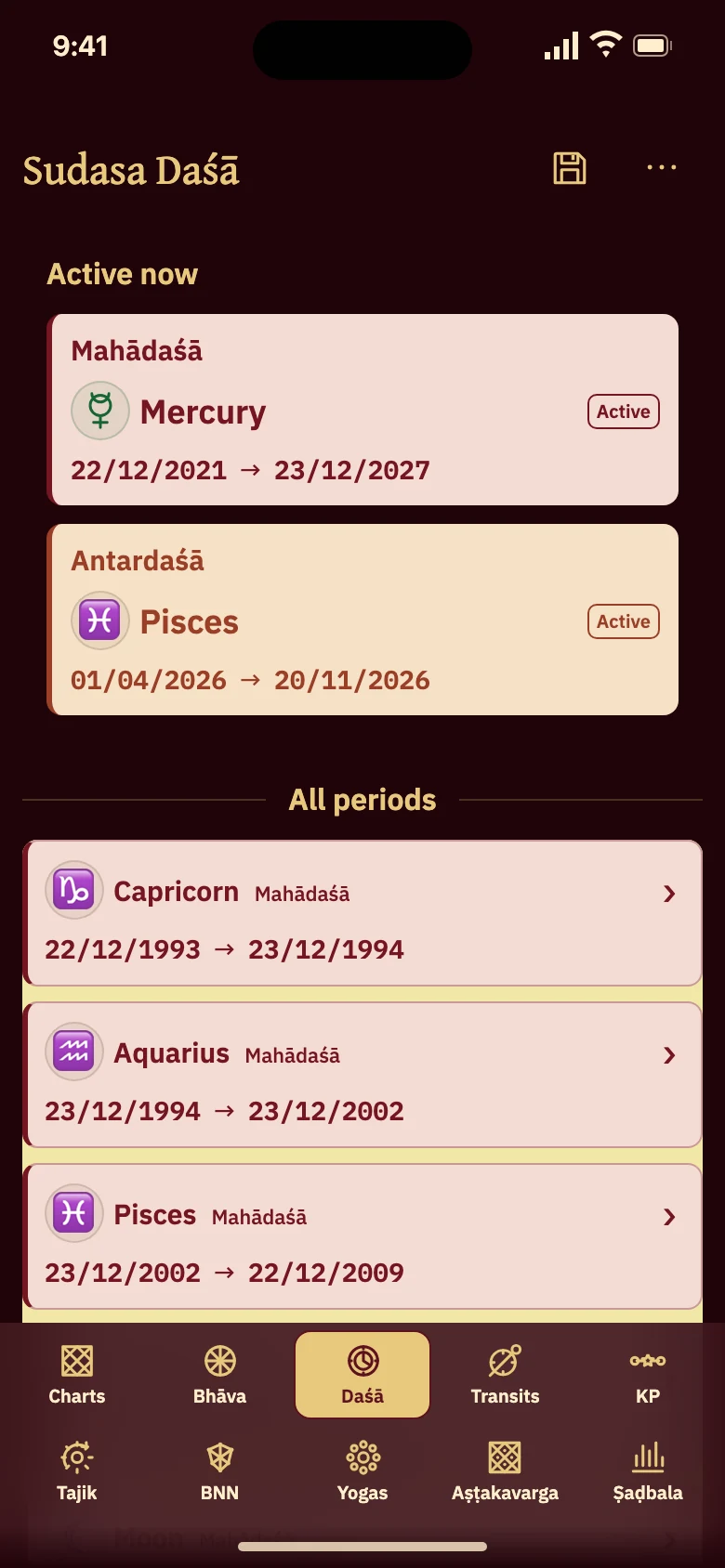
This genuine preview opens Sudasa on Nila Raman’s prepared chart. To read your own periods, open the intended saved chart in Mạghā and choose the same system.
Open Sudaśā in Mạghā