
Ṣaṣṭihāyanī Daśā spans 60 years
Ṣaṣṭihāyanī Daśā spans sixty years: Jupiter, Sun and Mars receive ten each; Moon, Mercury, Venus, Saturn and Rāhu receive six each. Ketu is excluded. Mạghā labels the dated period reader Shastihayani.
Bars use the saved duration in days: Sun 10 years, Mars 10 years, Moon 6 years, Mercury 6 years, Venus 6 years, Saturn 6 years, Rahu 6 years, Jupiter 10 years. The birth marker is 14 October 1994. This chart runs from 1994-02-03 to 2054-02-04.
Birth marker · 14 Oct 1994
- 01Sun3 Feb 1994 →
4 Feb 2004 - 02Mars4 Feb 2004 →
4 Feb 2014 - 03Moon4 Feb 2014 →
4 Feb 2020 - 04Mercury4 Feb 2020 →
4 Feb 2026 - 05Venus4 Feb 2026 →
4 Feb 2032 - 06Saturn4 Feb 2032 →
4 Feb 2038 - 07Rahu4 Feb 2038 →
4 Feb 2044 - 08Jupiter4 Feb 2044 →
4 Feb 2054
Widths follow the saved duration in days. Dates are shown in UTC. Gold marks the current period.
See Venus inside Nila's saved 60-year schedule
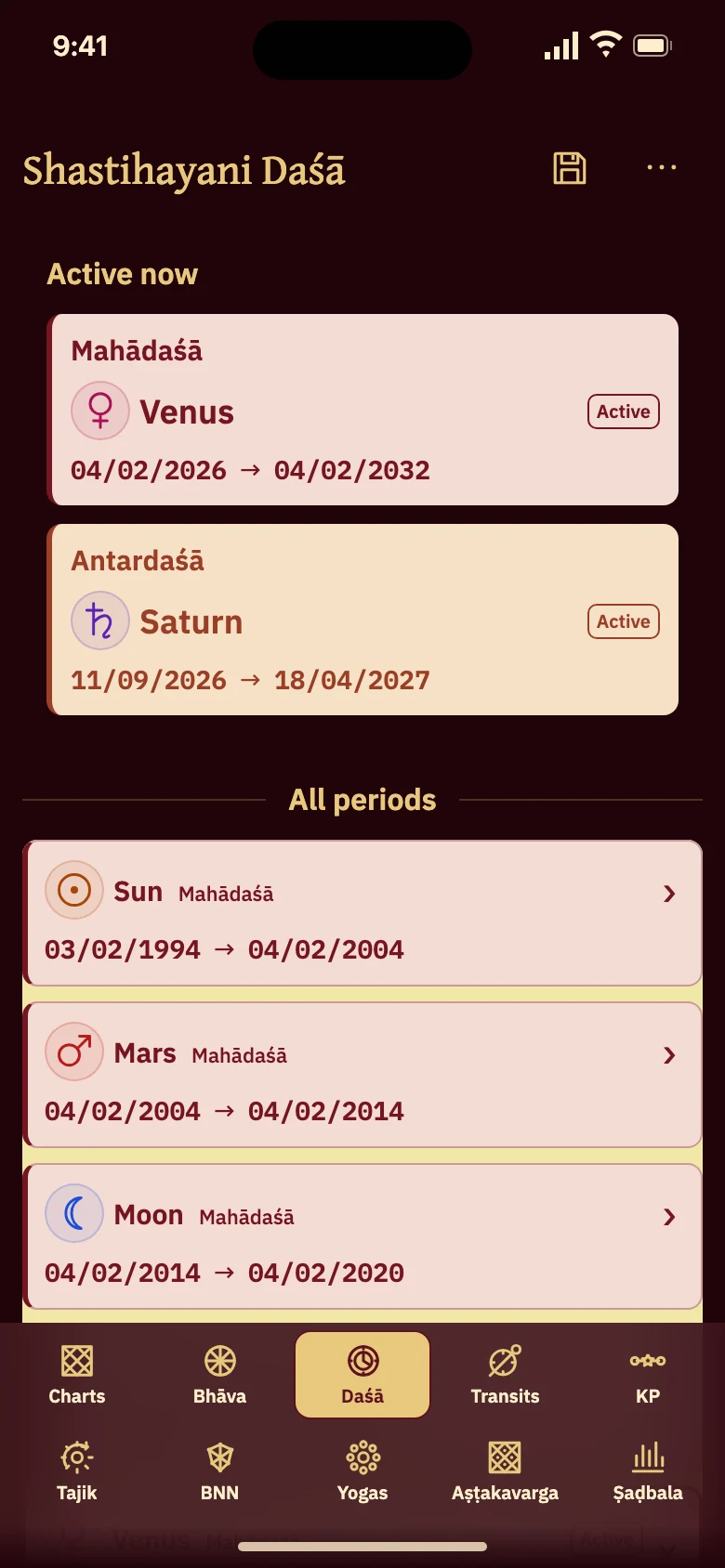
Nila's saved timeline begins with a Sun period in February 1994, before her October birth. Mars follows in February 2004, the Moon in February 2014 and Mercury in February 2020. Venus begins on 4 February 2026 and ends on 4 February 2032.
The demonstration is fixed on 12 September 2026. Venus is the major lord, with Saturn as the antardaśā lord. Saturn's displayed sub-period has just begun, on 11 September 2026, and ends on 18 April 2027. The larger Venus period continues after that smaller Saturn span finishes.
The diagram uses the recorded dates and day lengths to show the contrast between ten-year and six-year periods. It also marks Nila's birth inside the first period. The saved cycle ends in February 2054; the illustration does not extend it by inventing further sample periods.
Parāśara connects this method with the Sun in Lagna
Parāśara's recorded condition for Ṣaṣṭihāyanī is the Sun in the ascendant sign, or Lagna. This is a relationship within the birth chart. It does not mean the Sun must be the current major lord, and a period's ten-year or six-year length does not itself establish the condition.
Consider that traditional choice before interpreting the schedule. If a school uses a conditional daśā alongside Vimśottarī, keep each method's period names and dates together. The availability of a system in a picker is not a replacement for examining the chart under the rule you follow.
In the sample, the current Venus and Saturn labels refer to nested timing levels. They should be read alongside the planets' places in the birth chart, rather than treated as an event forecast simply because two planetary names appear in an active-period list.
Choose Shastihayani and open its sub-periods
Choose Shastihayani under Graha Daśās. The phone preview opens at Antardaśā depth with Venus/Saturn current; options reveal Pratyantardaśā and Sūkṣma. Read each subdivision within its major period. This fixed demonstration retains Nila's saved Lahiri chart. It shows prepared period output without checking the traditional Sun-in-Lagna condition, which must be established before applying the method to a personal chart.
Questions about Ṣaṣṭihāyanī Daśā
Are all Ṣaṣṭihāyanī periods the same length?
No. Jupiter, the Sun and Mars receive ten years each, and the Moon, Mercury, Venus, Saturn and Rāhu receive six each. Together they make sixty years. The timeline scales the saved major periods by their actual duration in days, so the two lengths are not drawn as equal blocks.
Is Ketu included in this 60-year cycle?
Ketu is omitted. Rāhu is included with a six-year major-period allocation. The method therefore differs from the nine-lord Vimśottarī cycle in both its participants and its total length. Use the selected system's own order when reading the full period list.
What does the Sun-in-Lagna condition refer to?
It refers to the Sun occupying the birth chart's ascendant sign in the traditional description. It does not mean choosing a date on which the Sun rules a period. The condition and the displayed period schedule answer different questions, so examine the birth chart before deciding how to use the method.
Why does the sample highlight Venus and Saturn together?
Venus is the enclosing mahādaśā on the fixed September 2026 reference date, and Saturn is its current antardaśā. The Saturn row runs from September 2026 to April 2027 inside Venus's February 2026 to February 2032 period. The two rows show a hierarchy, not two separate methods.
Open your Ṣaṣṭihāyanī Daśā periods
Read your own major periods and the dated sub-periods inside them. Ṣaṣṭihāyanī Daśā is free for life, like every astrology feature in Mạghā.
Open your charts