


Buddhi Gati Daśā adds another planetary sequence
Buddhi Gati Daśā is an experimental planetary period option, labelled Buddhi Gathi in Mạghā. It lists main periods and dated subdivisions beside the chart. The worked timeline illustrates saved output for Nila Raman’s chart.
Saved main periods for Nila Raman’s chart at 12 September 2026. All 9 main periods are shown with their recorded lengths. The birth marker and current highlight follow the saved fixture.
Birth marker · 14 Oct 1994
- 01Sun15 May 1994 →
15 May 2000 - 02Moon15 May 2000 →
15 May 2010 - 03Mars15 May 2010 →
15 May 2017 - 04Rahu15 May 2017 →
16 May 2035 - 05Ketu16 May 2035 →
16 May 2042 - 06Mercury16 May 2042 →
16 May 2059 - 07Jupiter16 May 2059 →
16 May 2075 - 08Venus16 May 2075 →
16 May 2095 - 09Saturn16 May 2095 →
17 May 2114
Widths follow the saved duration in days. Dates are shown in UTC. Gold marks the current period.
The sample’s main periods span nine planets
The saved result begins with the Sun in May 1994, followed by the Moon in May 2000 and Mars in May 2010. Rāhu follows in May 2017 and continues to May 2035. It is the highlighted main period at the sample’s September 2026 reference date.
Ketu, Mercury, Jupiter, Venus and Saturn complete the displayed sequence. The nine main periods have unequal lengths, which the bars preserve from the fixture’s recorded days. The first period starts before Nila’s October 1994 birth, and the birth marker shows her position within it.

Compare named methods without merging them
A comparison begins with the selected system’s own period list. Keep Buddhi Gati’s name attached to its dates when you place them beside Vimśottarī or another daśā, rather than borrowing one system’s rules to explain another system’s output.
The materials supplied for this page do not establish a classical verse or a single accepted interpretation for Buddhi Gati. The guide therefore concentrates on what can be demonstrated: the menu entry, the saved planetary sequence and the real dated period screen.
Use the main period to locate the longer interval, then inspect its sub-periods in the app. The fixed example is a way to learn that navigation; it is not a reading of a visitor’s chart or a promise about an event.

Select Buddhi Gathi in the Daśā menu
Open your saved chart and the Daśā options menu. Choose Experimental, then Buddhi Gathi. On a phone, the active main period and sub-period appear above the expandable list. The preview selects the real option on Nila’s chart.
Experimental in Mạghā identifies this as an option for study, without certifying agreement with every other implementation. The demonstrated screen supplies planetary periods. Annual, monthly or sixty-hour method controls are not part of the walkthrough, so the guide does not promise those settings.
Note: This page describes the supplied Buddhi Gati period display; it does not establish a classical attribution or an accuracy guarantee.
Questions about Buddhi Gati Daśā
Why is the picker spelling Buddhi Gathi?
That is the app’s label for this option. Choose Buddhi Gathi under Experimental to reach the period list described here.
Is Buddhi Gati the same as Vimśottarī?
They are separate options in the app. This saved Buddhi Gati sequence begins with the Sun, while Nila’s saved Vimśottarī sequence has its own starting lord and dates. Keep the selected method attached to each list.
Can I enter my own chart in the embedded preview?
No. The preview uses Nila Raman’s chart at a fixed date. Open your charts in the app to work with a chart of your own.
Choose Buddhi Gati Daśā on your chart
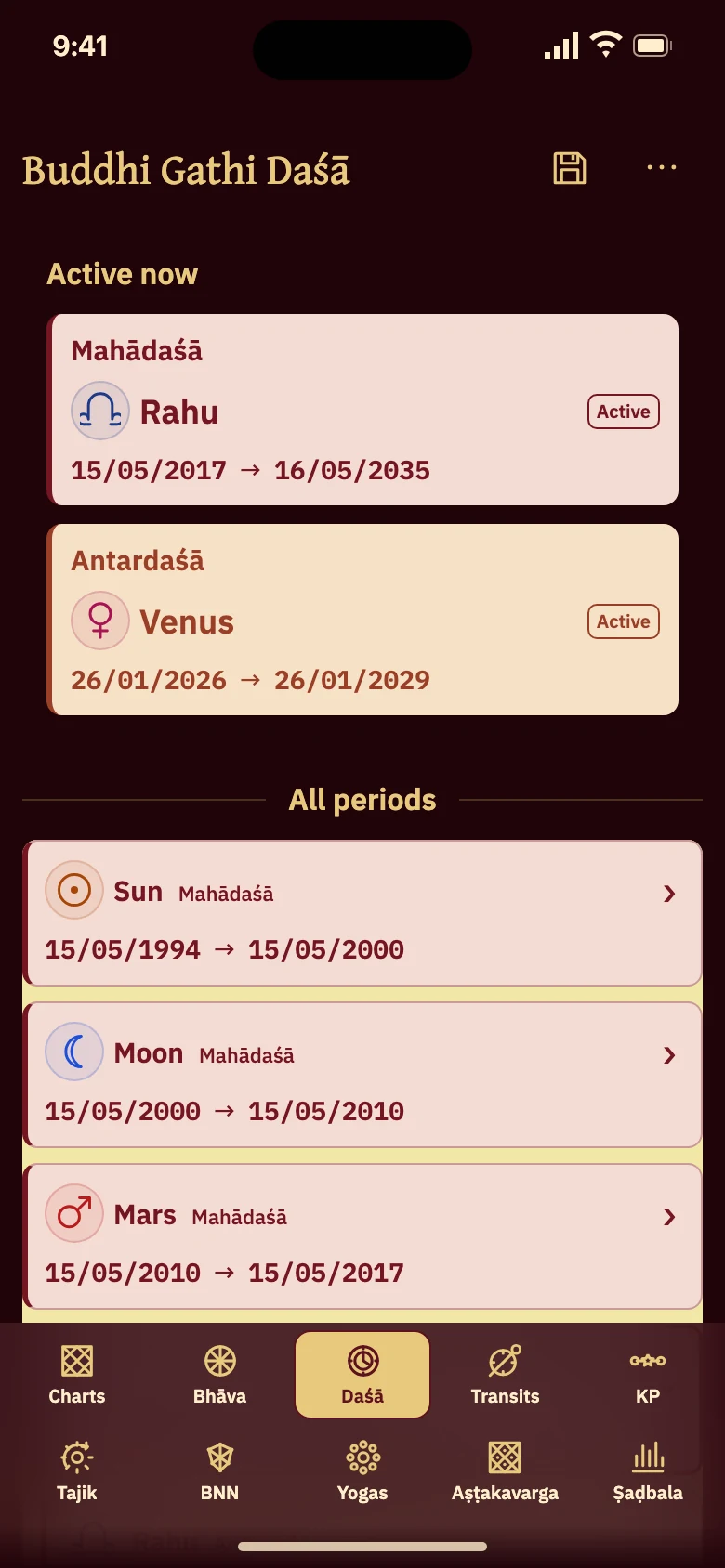
Select Buddhi Gathi on your saved chart. The demo uses a phone layout on all screens and shows Nila Raman's fixed sample.
Open your daśā periods