

Dvādaśottarī Daśā spans 112 years
Dvādaśottarī Daśā divides 112 years among eight planetary lords. Both lunar nodes participate; Venus does not. Allocations rise from seven to twenty-one years. Mạghā lists dated main periods and subdivisions under the name Dwadasottari.
Bars use the saved duration in days: Moon 21 years, Sun 7 years, Jupiter 9 years, Ketu 11 years, Mercury 13 years, Rahu 15 years, Mars 17 years, Saturn 19 years. The birth marker is 14 October 1994. This chart runs from 1993-05-02 to 2105-05-04.
Birth marker · 14 Oct 1994
- 01Moon2 May 1993 →
3 May 2014 - 02Sun3 May 2014 →
2 May 2021 - 03Jupiter2 May 2021 →
3 May 2030 - 04Ketu3 May 2030 →
2 May 2041 - 05Mercury2 May 2041 →
3 May 2054 - 06Rahu3 May 2054 →
3 May 2069 - 07Mars3 May 2069 →
3 May 2086 - 08Saturn3 May 2086 →
4 May 2105
Widths follow the saved duration in days. Dates are shown in UTC. Gold marks the current period.
Nila's saved schedule now runs through Jupiter
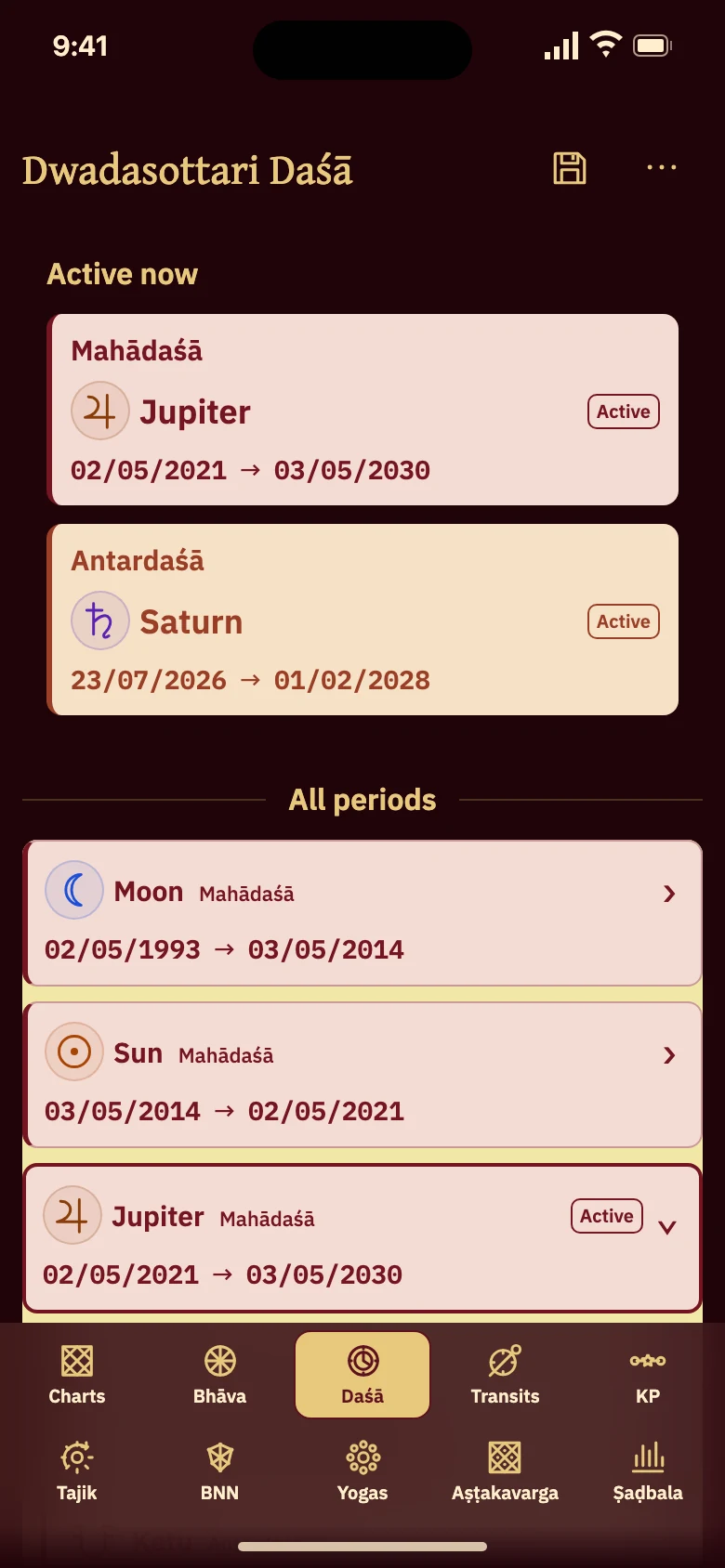
Nila's saved Dvādaśottarī schedule opens with the Moon in May 1993. That long first period ends in May 2014, followed by the Sun until May 2021. Jupiter's major period then runs from 2 May 2021 to 3 May 2030.
The reference date is 12 September 2026. At that point, the prepared result shows Saturn as the antardaśā lord within Jupiter. Saturn's sub-period runs from 23 July 2026 to 1 February 2028. Read Jupiter as the enclosing period and Saturn as the shorter layer, rather than as two competing answers.
Each timeline segment is scaled from the saved duration in days. The birth marker falls inside the opening Moon period, and all eight major periods extend through May 2105. The diagram describes this one recorded sample; it does not calculate a fresh result for the person reading the page.

The classical condition concerns the D9 ascendant
Parāśara assigns Dvādaśottarī to a chart whose ascendant falls in a navāṁśa of Venus. In the recorded traditional description, those are the Taurus or Libra navāṁśas. The relevant question is the ascendant in the ninth-part chart, D9, rather than merely whether Venus happens to be a current period lord.
That distinction helps avoid selecting a method from its name or cycle length alone. Check the applicability rule used by your tradition along with the birth data and chart settings. A complete-looking list of dates is not an independent assessment of whether a conditional method suits a chart.
The larger and smaller periods remain useful to read as a hierarchy once the method is chosen. Compare another system on the same birth chart under its own name, without carrying Dvādaśottarī's Jupiter dates into a different daśā's sub-period list.

Read Dwadasottari on your chart page
Choose Dwadasottari under Graha Daśās. Its dated tree opens from Mahādaśā through Sūkṣma; the phone preview starts at Antardaśā, showing Jupiter/Saturn current and the full sequence beginning with Moon. It uses Nila's saved Lahiri chart at a fixed September 2026 moment. For personal use, verify birth inputs, settings and the traditional Venus-navāṁśa condition. The prepared output does not establish that condition.
Questions about Dvādaśottarī Daśā
Does Dvādaśottarī include Venus?
No. Its eight major lords include both lunar nodes but omit Venus. The period allocations are 7, 9, 11, 13, 15, 17, 19 and 21 years in the system's order. Their total is 112 years; the opening lord in a particular chart can occur partway through that order.
Why does the app say Dwadasottari?
Dwadasottari is the catalogue's ASCII spelling. The guide uses Dvādaśottarī, and Dwadashottari is the route's English spelling. They refer to the same selection here. Confirm the method in the card heading when moving between this system and another planetary daśā.
Which chart is used for the traditional condition?
The recorded Parāśara rule concerns the ascendant's navāṁśa, or D9 position, in a sign belonging to Venus: Taurus or Libra. This is separate from the major and sub-period dates displayed in the card. Refer to the applicability rule used by your school before treating a conditional method as the right choice.
Can I inspect the Saturn sub-period in the example?
Yes. The preview selects the real Dwadasottari result at Antardaśā depth. On its fixed date, Jupiter is the major lord and Saturn the sub-period lord. Saturn is displayed from July 2026 to February 2028. These are Nila's saved dates, not a calculation from your own birth details.
Open your Dvādaśottarī Daśā periods
Read your own major periods and the dated sub-periods inside them. Dvādaśottarī Daśā is free for life, like every astrology feature in Mạghā.
Open your charts