

Aṣṭottarī Daśā spans 108 years
Aṣṭottarī Daśā divides 108 years among eight planetary lords, including Rāhu but excluding Ketu. Mạghā displays its major periods and dated sub-periods beside your birth chart. Each lord receives a different number of years.
Bars use the saved duration in days: Moon 15 years, Mars 8 years, Mercury 17 years, Saturn 10 years, Jupiter 19 years, Rahu 12 years, Venus 21 years, Sun 6 years. The birth marker is 14 October 1994. This chart runs from 1993-09-30 to 2101-10-02.
Birth marker · 14 Oct 1994
- 01Moon30 Sept 1993 →
30 Sept 2008 - 02Mars30 Sept 2008 →
30 Sept 2016 - 03Mercury30 Sept 2016 →
1 Oct 2033 - 04Saturn1 Oct 2033 →
1 Oct 2043 - 05Jupiter1 Oct 2043 →
1 Oct 2062 - 06Rahu1 Oct 2062 →
1 Oct 2074 - 07Venus1 Oct 2074 →
2 Oct 2095 - 08Sun2 Oct 2095 →
2 Oct 2101
Widths follow the saved duration in days. Dates are shown in UTC. Gold marks the current period.
Follow the sample from the Moon to Mercury
Nila's saved Aṣṭottarī cycle begins with the Moon in September 1993, before her birth in October 1994. The Moon period ends in September 2008, followed by Mars until September 2016. Mercury then runs from 30 September 2016 to 1 October 2033.
The reference date for this example is 12 September 2026. Mercury is the major lord, and Venus is the sub-period lord. The Venus antardaśā shown in the prepared result runs from 17 November 2025 to 8 March 2029.
The diagram draws the saved major periods in order and scales their widths by their duration in days. A birth marker distinguishes the start of Nila's life from the earlier start of the first period. The illustrated cycle ends in October 2101; it is a sample schedule, not a prediction about the visitor.
Check the condition before choosing Aṣṭottarī
Parāśara's conditional rules consider Rāhu in a kendra or trikoṇa from the ascendant lord, excluding Rāhu in the ascendant, and also discuss day/night birth and lunar fortnight. Establish your school's rule before interpreting the schedule; a menu option does not establish eligibility. In the sample, Venus is a sub-period within Mercury, so both lords must be read with the birth chart rather than as promises of events.
Open the Ashtottari periods in Mạghā
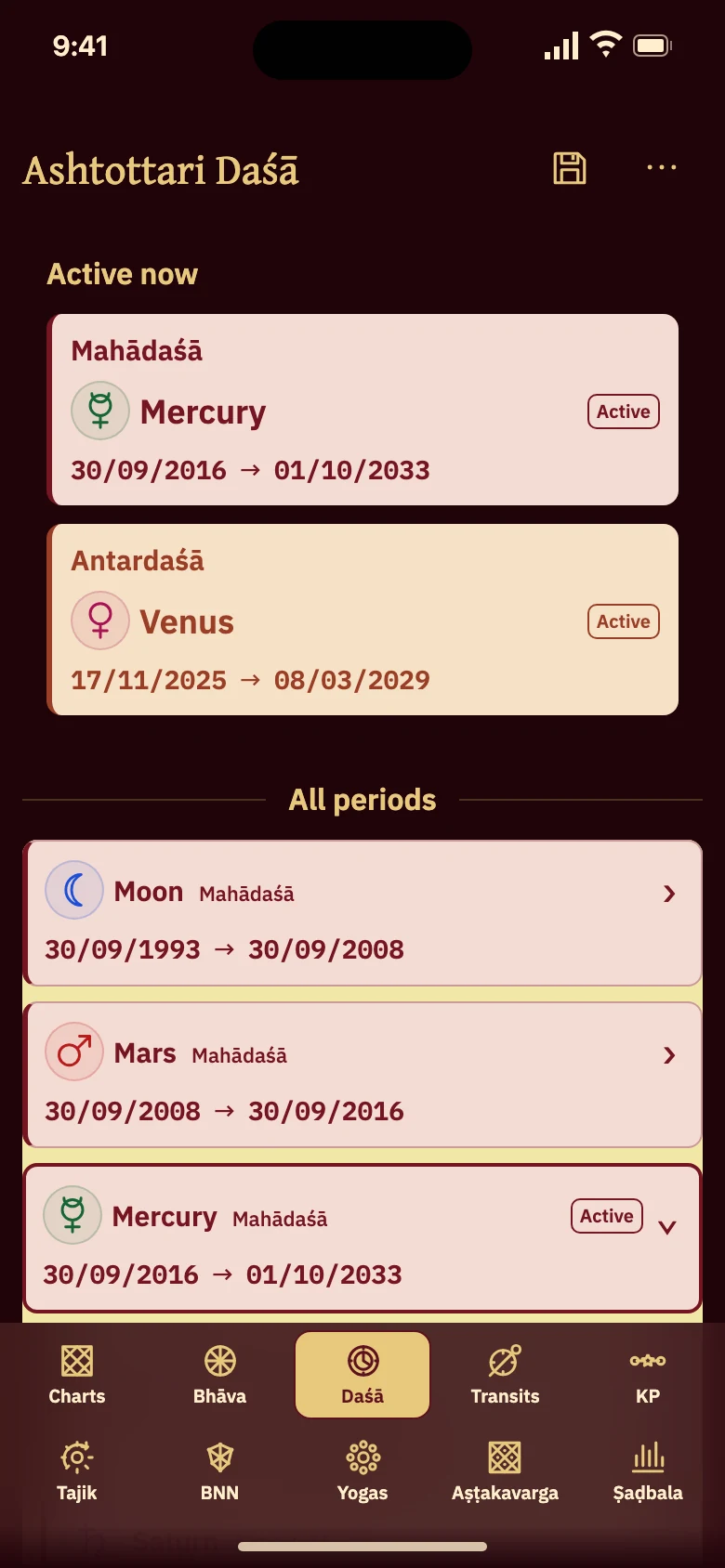
Choose Ashtottari under Graha Daśās in the Daśā card. The preview opens at Antardaśā depth, with Mercury/Venus current and all major periods listed; options extend through Sūkṣma. It retains Nila's saved Lahiri chart and fixed reference date. For your own chart, verify birth details, calculation settings and the traditional applicability rule. The prepared sample does not determine whether that rule is satisfied.
Questions about Aṣṭottarī Daśā
Does Aṣṭottarī Daśā include Ketu?
No. Its eight lords are the Sun, Moon, Mars, Mercury, Saturn, Jupiter, Rāhu and Venus. Ketu has no major period in this system. Rāhu does, with a 12-year allocation; that is one reason Aṣṭottarī should not be read as a shortened Vimśottarī list.
Why can Aṣṭottarī and Vimśottarī show different lords?
They use different schedules and period lengths. For Nila on the fixed sample date, Aṣṭottarī shows Mercury with Venus, while the Vimśottarī example shows Jupiter with Ketu. Compare each under its own name and rules; a difference between the two does not mean the birth details have changed.
Can I open the Aṣṭottarī antardaśās?
Yes. Choose Ashtottari in the Graha Daśās group and read the nested period list. The demonstration starts at Antardaśā depth, with a major-period row and its current sub-period row. Its options offer finer displayed levels through Sūkṣma. The sample accepts no replacement birth details.
What does the balance of a period mean?
It is the portion of the opening major period that remains at birth. A prepared timeline can therefore begin before the birth marker. Nila's saved Aṣṭottarī example does this with the Moon. Keep the displayed opening date separate from the date of birth when reading the first row.
Open your Aṣṭottarī Daśā periods
Read your own major periods and the dated sub-periods inside them. Aṣṭottarī Daśā is free for life, like every astrology feature in Mạghā.
Open your charts