
Caturaśīti Sama Daśā
Caturaśīti Sama Daśā divides 84 years equally among the Sun-to-Saturn planets, with no periods for the lunar nodes. Parāśara prescribes it when the tenth lord occupies the tenth house. Mạghā shows the periods and dated subdivisions.
Seven equal 12-year bars run from December 1993, ten months before birth, to December 2077: Moon, Mars, Mercury (current, December 2017 to December 2029), Jupiter, Venus, Saturn and the Sun.
Birth marker · 14 Oct 1994
- 01Moon15 Dec 1993 →
15 Dec 2005 - 02Mars15 Dec 2005 →
15 Dec 2017 - 03Mercury15 Dec 2017 →
15 Dec 2029 - 04Jupiter15 Dec 2029 →
15 Dec 2041 - 05Venus15 Dec 2041 →
15 Dec 2053 - 06Saturn15 Dec 2053 →
16 Dec 2065 - 07Sun16 Dec 2065 →
16 Dec 2077
Widths follow the saved duration in days. Dates are shown in UTC. Gold marks the current period.
Counting from Svātī picks your first planet
Count inclusively from Svātī to the birth Moon's nakṣatra, then take the remainder modulo seven: Sun through Saturn in weekday order, with zero meaning Saturn. Moon progress sets the elapsed opening portion. Nila's Dhaniṣṭhā gives count 9, remainder 2: Moon first. With 6.9% elapsed, about 11 years 2 months remain. Her chart periods begin December 1993, continue with Mars in 2005 and Mercury in 2017, and finish in December 2077.
Check the tenth-house condition
Parāśara recommends this 84-year daśā when the tenth-house lord occupies the tenth house. Its seven planetary lords receive twelve years each.
Nila has Libra rising: Cancer is her tenth house, but its ruler, the Moon, is in Capricorn in the fourth. Her chart does not qualify; the example demonstrates the method only.
Equal duration does not imply equal results. Traditional interpretation considers each period lord’s strength and placement.
Caturaśīti Sama in Mạghā
Choose Graha Daśās → Chathuraseethi Sama in the Daśā menu. The card uses that app spelling and lists all seven periods.
Four levels run from Mahādaśā to Sūkṣma, with dated sub-periods of equal sevenths. Mạghā uses 365.2564-day sidereal years and the selected ayanāṁśa, Lahiri by default.
Note: Mạghā calculates this system for every chart. It does not check whether the tenth lord occupies the tenth house; verify that condition yourself.
Each bar is one seventh of Mercury's 12 years, about 626 days: Mercury, Jupiter, Venus, Saturn, Sun, Moon (current, July 2026 to March 2028) and Mars, which ends the period in December 2029.
- 01Mercury15 Dec 2017 →
2 Sept 2019 - 02Jupiter2 Sept 2019 →
21 May 2021 - 03Venus21 May 2021 →
6 Feb 2023 - 04Saturn6 Feb 2023 →
24 Oct 2024 - 05Sun24 Oct 2024 →
12 Jul 2026 - 06Moon12 Jul 2026 →
29 Mar 2028 - 07Mars29 Mar 2028 →
15 Dec 2029
Widths follow the saved duration in days. Dates are shown in UTC. Gold marks the current period.
Nila's Moon antardaśā runs inside Mercury until March 2028
On 12 September 2026, the reference date, Nila Raman is in her Mercury period, which runs from December 2017 to December 2029. Its seven antardaśās (sub-periods) begin with Mercury and keep the cycle's order: Mercury, Jupiter, Venus, Saturn, Sun, Moon, Mars.
Each is 12 years divided by seven, 1.71 years or about 626 days. Nila's Moon antardaśā began in July 2026 and runs to late March 2028, when Mars takes the last share of the period, ending in December 2029.
In Mạghā, the division repeats at every level: each antardaśā holds seven pratyantardaśās of about 89 days, and each of those holds seven sūkṣmas of about 13 days.
Questions about Caturaśīti Sama Daśā
Which charts does Caturaśīti Sama Daśā apply to?
Parāśara gives it to charts whose 10th lord sits in the 10th house. Count ten signs from the ascendant, counting the ascendant as one, find that sign's ruler and see whether it occupies that sign. A Leo ascendant qualifies with Venus in Taurus, for example, and an Aries ascendant with Saturn in Capricorn. Most charts do not meet the condition.
In what order do the 12-year periods run?
Always in weekday order (Sun, Moon, Mars, Mercury, Jupiter, Venus, Saturn), starting from the lord your Moon's nakṣatra picks and wrapping round. A Moon in Dhaniṣṭhā starts with the Moon, so the cycle runs Moon, Mars, Mercury, Jupiter, Venus, Saturn, Sun. Inside each period the sub-periods follow the same order, starting with that period's own lord.
How does Caturaśīti Sama differ from Dvisaptati Sama Daśā?
Both are conditional, equal-period daśās whose first lord comes from the Moon's nakṣatra. Caturaśīti gives seven planets 12 years each (84 in all), counted from Svātī, for a 10th lord in the 10th house. Dvisaptati gives eight lords, the seven planets and Rāhu, 9 years each (72 in all), counted from Mūla, when the ascendant's lord is in the 7th house or the 7th lord is in the ascendant.
Choose Caturaśīti Sama Daśā on your chart in Mạghā
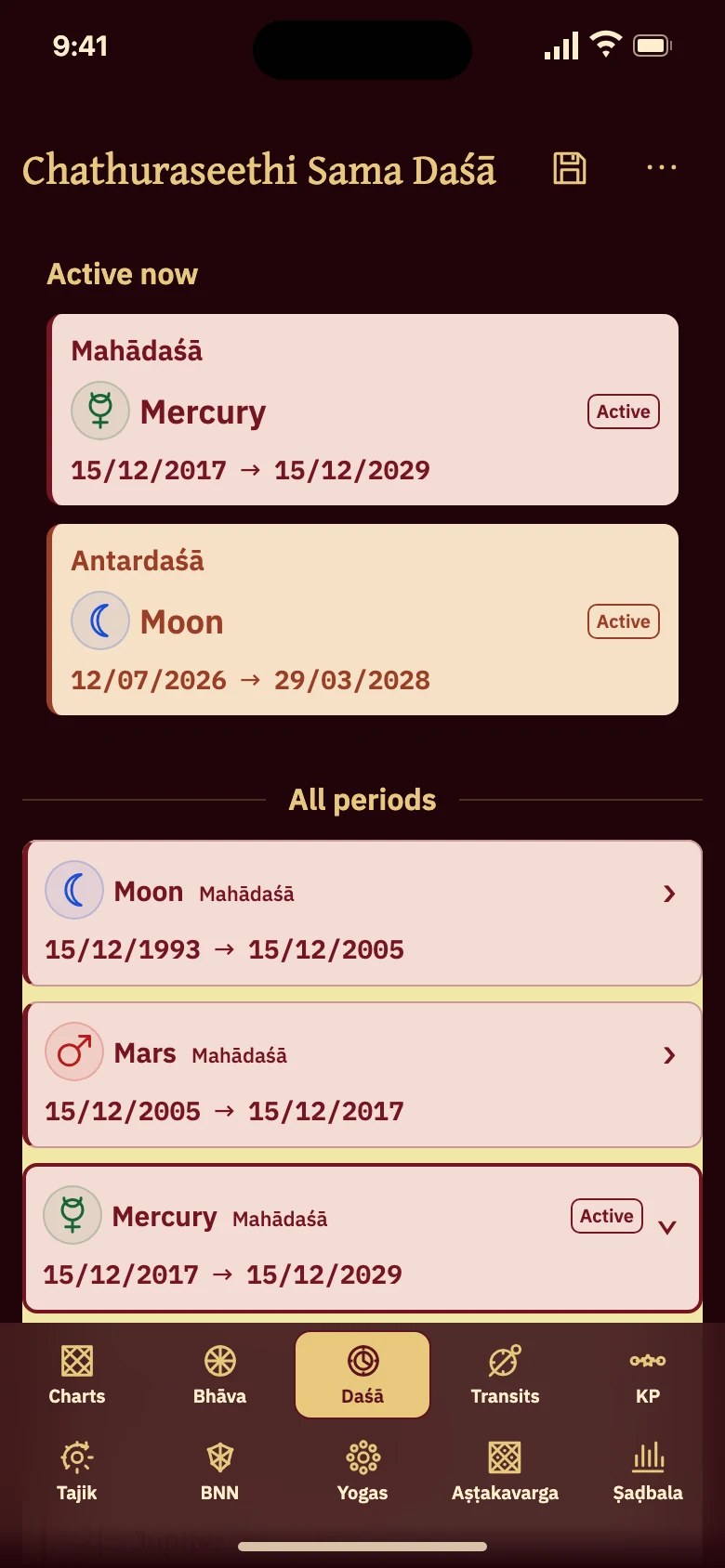
Select Chathuraseethi Sama in Graha Daśās. The chart shows Mercury–Moon on 12 September 2026 but does not meet Parāśara's applicability condition; it illustrates the method rather than a reading.
Open your charts