
Śatābdikā Daśā
Śatābdikā Daśā distributes one hundred years among seven planets, excluding the nodes. Parāśara prescribes it when the Ascendant is vargottama, the same sign in D1 and D9. Mạghā displays the major periods and their dated subdivisions.
Bars are sized by length: Venus 10 years (begun February 1994, before birth), Mercury 10, Jupiter 20 (current, February 2014 to February 2034), Mars 20, Saturn 30, Sun 5 and Moon 5, ending in February 2094. The chart is Mạghā's chart, whose vargottama Libra Lagna meets Parāśara's condition.
Birth marker · 14 Oct 1994
- 01Venus3 Feb 1994 →
4 Feb 2004 - 02Mercury4 Feb 2004 →
4 Feb 2014 - 03Jupiter4 Feb 2014 →
4 Feb 2034 - 04Mars4 Feb 2034 →
4 Feb 2054 - 05Saturn4 Feb 2054 →
5 Feb 2084 - 06Sun5 Feb 2084 →
4 Feb 2089 - 07Moon4 Feb 2089 →
4 Feb 2094
Widths follow the saved duration in days. Dates are shown in UTC. Gold marks the current period.
Your birth star, counted from Revatī, sets the first period
Parāśara counts from Revatī, the last nakṣatra (lunar mansion), to the one holding the Moon at birth, and divides by seven. A remainder of one gives the Sun, two the Moon, then Venus, Mercury, Jupiter and Mars; no remainder gives Saturn. As in Vimśottarī, the share of the nakṣatra the Moon has already crossed counts as time already spent in that first period.
Nila Raman's Moon sits early in Dhaniṣṭhā, the 24th nakṣatra counting from Revatī. Twenty-four divided by seven leaves three, so her cycle opens with Venus. About 7% of Dhaniṣṭhā had passed, so Venus's 10 years began in February 1994, about eight months before she was born. Mercury followed in February 2004 and Jupiter in February 2014. The timeline draws all seven periods to scale; her cycle ends in February 2094.

Parāśara turns to Śatābdikā when the Lagna is vargottama
Parāśara's condition is a single test: consider Śatābdikā when the Lagna is vargottama. One English translation spells it out: the Lagna's sign in the birth chart and in the navāṁśa must be the same. Every sign has one 3°20′ slice where that happens, a ninth of the sign.
When a chart qualifies, its Śatābdikā periods are judged like any planetary period in Parāśara's scheme, by each lord's strength and placement. Vimśottarī remains his system for people in general, so a vargottama chart can carry both timelines.
Nila Raman qualifies. Her Lagna is Libra at 0°46′, inside Libra's first navāṁśa, which is Libra itself. Her Śatābdikā periods can therefore sit beside her Vimśottarī ones.
Śatābdikā in Mạghā
Choose Graha Daśās → Sataatbika, the app’s spelling. Seven mahādaśās expand through Antardaśā, Pratyantardaśā and Sūkṣma, with dated boundaries.
Sub-periods follow proportional lord-years, starting with the parent lord. Mạghā uses 365.2564-day sidereal years, the chosen ayanāṁśa and one 100-year cycle.
Note: Mạghā does not check the classical condition: a vargottama Lagna, occupying the same sign in D1 and D9. Verify it yourself.
Each bar is Jupiter's 20 years times its antardaśā lord's years divided by 100, from Saturn's 6 years down to one year each for the Sun and Moon. Saturn, the current sub-period, runs from February 2022 to February 2028.
- 01Jupiter4 Feb 2014 →
4 Feb 2018 - 02Mars4 Feb 2018 →
4 Feb 2022 - 03Saturn4 Feb 2022 →
4 Feb 2028 - 04Sun4 Feb 2028 →
3 Feb 2029 - 05Moon3 Feb 2029 →
4 Feb 2030 - 06Venus4 Feb 2030 →
4 Feb 2032 - 07Mercury4 Feb 2032 →
4 Feb 2034
Widths follow the saved duration in days. Dates are shown in UTC. Gold marks the current period.
Nila's Saturn antardaśā fills six years of her Jupiter period
On 12 September 2026, the reference date, Nila Raman is in her Śatābdikā Jupiter mahādaśā, which runs from February 2014 to February 2034. Its seven antardaśās begin with Jupiter and keep the cycle's order: Jupiter, Mars, Saturn, Sun, Moon, Venus, Mercury.
Mạghā gives each one Jupiter's 20 years multiplied by its lord's years and divided by 100. Saturn's share is 20 × 30 ÷ 100 = 6 years, so Nila's Saturn antardaśā runs from February 2022 to February 2028, the longest stretch in the period. Jupiter and Mars take 4 years each, Venus and Mercury 2, and the Sun and Moon 1 year each.
With these dates, an astrologer would weigh Jupiter's strength and placement first, then Saturn's.
What people ask about Śatābdikā Daśā
Which charts use Śatābdikā Daśā?
Charts with a vargottama Lagna, the same sign in the birth chart and the navāṁśa. That happens in one 3°20′ slice of each sign: the first slice of Aries, Cancer, Libra and Capricorn; the middle slice, 13°20′ to 16°40′, of Taurus, Leo, Scorpio and Aquarius; and the last slice of Gemini, Virgo, Sagittarius and Pisces.
How is the 100-year Śatābdikā cycle divided?
Into seven mahādaśās: Sun 5 years, Moon 5, Venus 10, Mercury 10, Jupiter 20, Mars 20 and Saturn 30. Your cycle opens with the lord your Moon's nakṣatra gives, and part of that period passes before birth, so the cycle ends between 70 and 100 years after birth. Mạghā then shares each mahādaśā among the seven lords in proportion to their years.
How is Śatābdikā different from Vimśottarī?
Vimśottarī gives 120 years to nine planets, including Rāhu and Ketu, and Parāśara recommends it for people in general. Śatābdikā gives 100 years to seven planets, counts from Revatī rather than Kṛttikā and is meant for vargottama ascendants. Its lengths are also more uneven: Saturn's 30 years are six times the Sun's 5.
Choose Śatābdikā Daśā on your chart in Mạghā
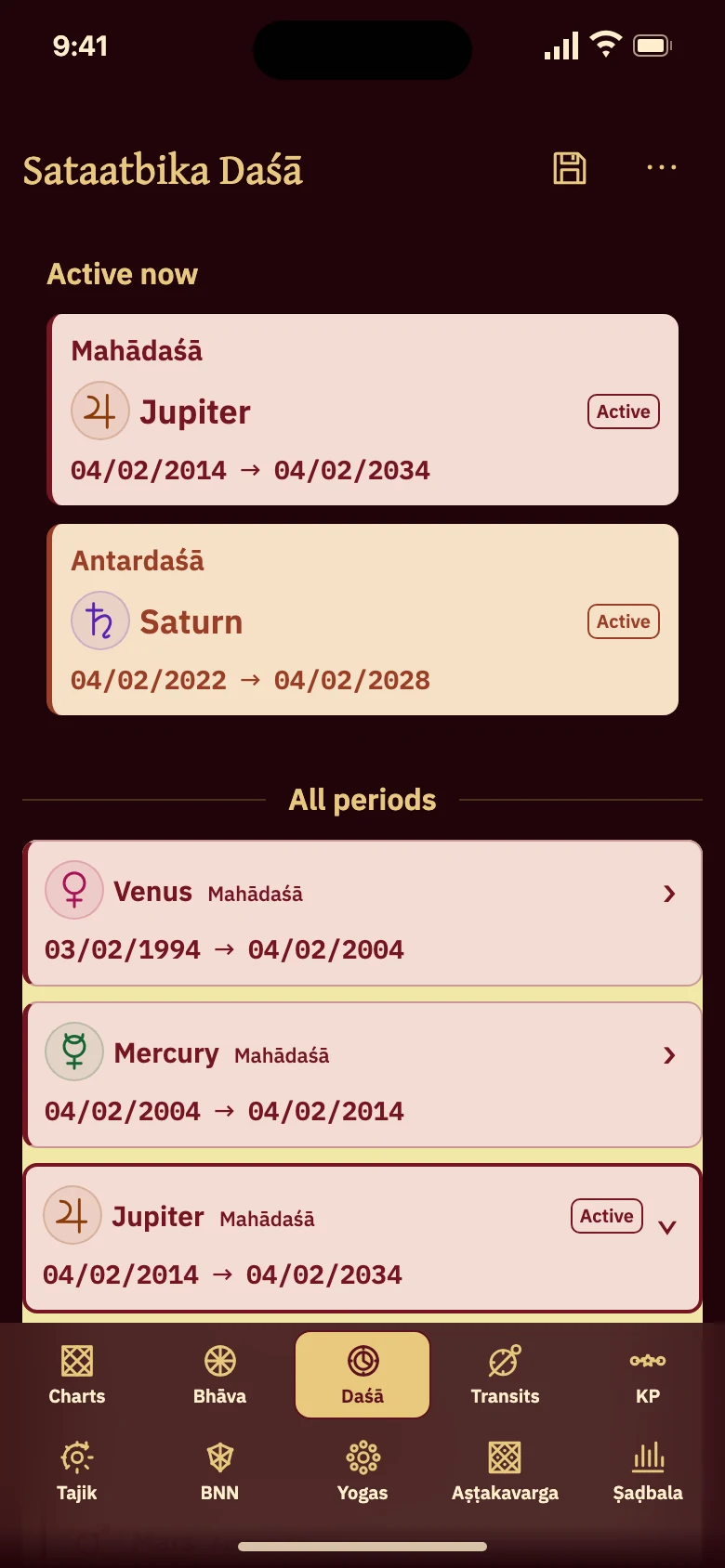
Select Sataatbika, Mạghā's label for Śatābdikā, on your saved chart. The Nila Raman demo shows Jupiter–Saturn at its reference date, 12 September 2026.
Open your charts