
Ṣoḍaśottarī Daśā spans 116 years
Ṣoḍaśottarī Daśā spans 116 years among eight planetary lords, with allocations rising from eleven to eighteen years. Ketu participates; Rāhu does not. Select Shodasottari in Mạghā to inspect its main periods and dated subdivisions.
Bars use the saved duration in days: Saturn 14 years, Ketu 15 years, Moon 16 years, Mercury 17 years, Venus 18 years, Sun 11 years, Mars 12 years, Jupiter 13 years. The birth marker is 14 October 1994. This chart runs from 1993-10-26 to 2109-10-27.
Birth marker · 14 Oct 1994
- 01Saturn26 Oct 1993 →
26 Oct 2007 - 02Ketu26 Oct 2007 →
26 Oct 2022 - 03Moon26 Oct 2022 →
26 Oct 2038 - 04Mercury26 Oct 2038 →
27 Oct 2055 - 05Venus27 Oct 2055 →
26 Oct 2073 - 06Sun26 Oct 2073 →
26 Oct 2084 - 07Mars26 Oct 2084 →
26 Oct 2096 - 08Jupiter26 Oct 2096 →
27 Oct 2109
Widths follow the saved duration in days. Dates are shown in UTC. Gold marks the current period.
See the Moon period inside Nila's saved cycle
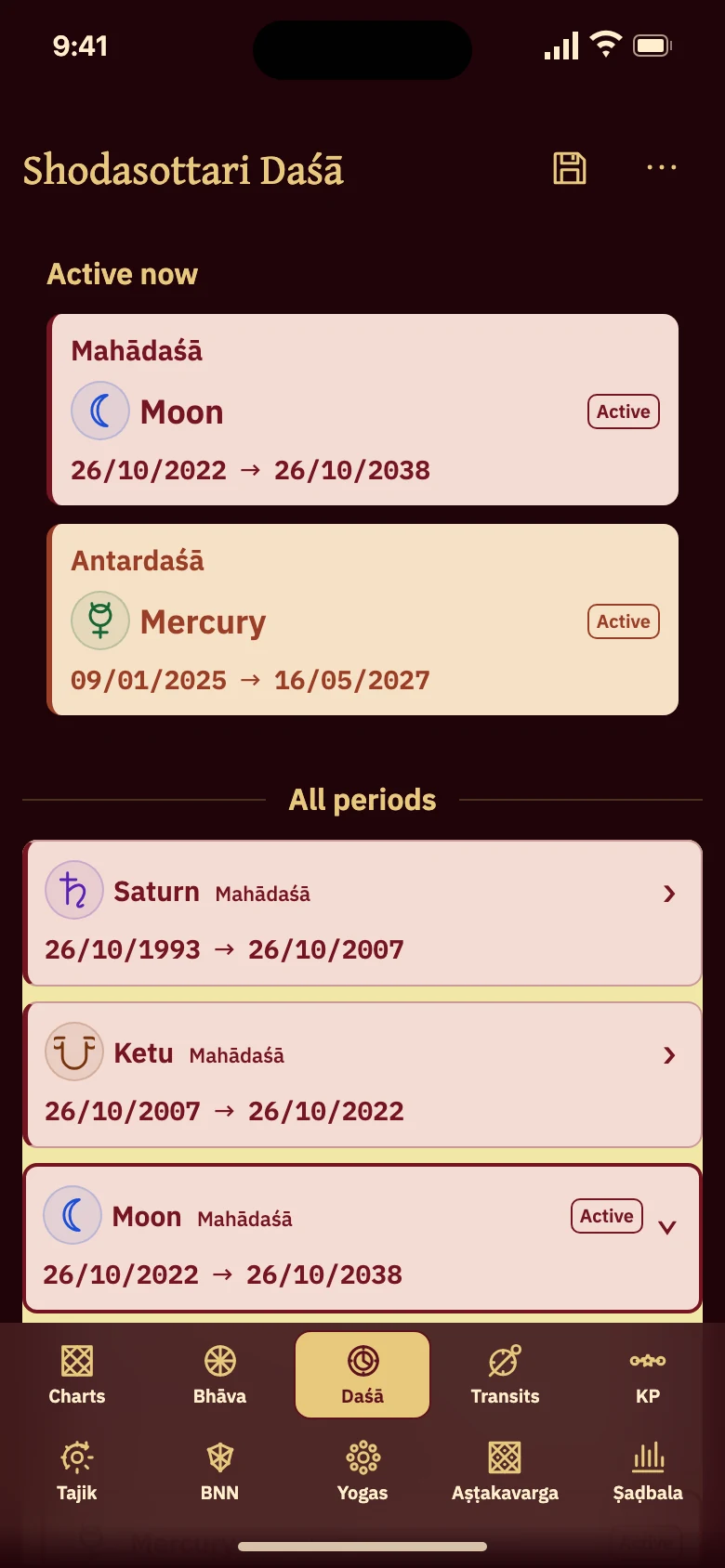
The saved sample opens with Saturn in October 1993 and moves to Ketu in October 2007. Ketu ends in October 2022, when the Moon's 16-year period begins. That Moon mahādaśā runs from 26 October 2022 to 26 October 2038 in the prepared result.
On the example's fixed date, 12 September 2026, Mercury is the antardaśā lord within the Moon period. The displayed Mercury sub-period runs from 9 January 2025 to 16 May 2027. The two names describe different levels of the same selected schedule.
The timeline uses the saved period dates and lengths rather than drawing equal decorative blocks. It includes the part of the first period before Nila's birth and follows all eight major periods through October 2109. A current marker belongs to the fixed sample date, not the day you happen to open this guide.
The traditional condition uses horā and lunar phase
Parāśara's description links Ṣoḍaśottarī to the ascendant's horā and the lunar fortnight. The recorded rule specifies the Moon's horā during the dark fortnight, or the Sun's horā during the bright fortnight. Horā here concerns a chart division, rather than simply a clock hour.
This condition is separate from identifying the current planet in an already prepared period list. Establish the applicable tradition and the birth-chart details before using the schedule as an interpretive framework. The system's availability in the picker is not a substitute for that choice.
A useful comparison keeps the same birth details and asks how the selected clocks divide time. Do not combine the Moon period from one system with a Mercury sub-period from another. In Nila's Ṣoḍaśottarī sample, Mercury is specifically a subdivision of the displayed Moon period.

Choose Shodasottari in the Graha menu
Choose Shodasottari under Graha Daśās. The phone preview opens at Antardaśā depth with Moon/Mercury current and a full sequence beginning with Saturn. Options show Mahādaśā through Sūkṣma; keep each smaller span connected to its parent. The saved Lahiri demonstration has fixed dates and does not assess the traditional horā and lunar-fortnight condition. Verify that condition before interpreting your own schedule.
Questions about Ṣoḍaśottarī Daśā
Is Shodasottari the same name as Ṣoḍaśottarī?
Yes. Shodasottari is the app's ASCII label for the system discussed here as Ṣoḍaśottarī Daśā. The route and common English spelling use Shodashottari. Check the selected method's card heading rather than expecting every spelling to include Sanskrit diacritics.
Which planet is left out of Ṣoḍaśottarī?
Rāhu is omitted. Ketu remains in the eight-lord sequence and has a 15-year major-period allocation. The other allocations run from the Sun's 11 years to Venus's 18 years, giving a total of 116. This is a different distribution from both Vimśottarī and Aṣṭottarī.
What is the difference between a major period and a sub-period?
The mahādaśā is the larger span, and an antardaśā is one of its subdivisions. In the saved example the Moon is the major lord from October 2022 to October 2038. Mercury's January 2025 to May 2027 sub-period sits inside it; the Moon remains the enclosing lord.
Can the preview calculate my Ṣoḍaśottarī dates?
No. It demonstrates one prepared result for the Nila Raman chart. To read your own schedule, sign in, open your chart and choose Shodasottari from Graha Daśās. Begin with the correct birth details and calculation settings, and consider the method's traditional condition separately.
Open your Ṣoḍaśottarī Daśā periods
Read your own major periods and the dated sub-periods inside them. Ṣoḍaśottarī Daśā is free for life, like every astrology feature in Mạghā.
Open your charts