


Trikoṇa Daśā
Trikoṇa Daśā is an experimental sign-period system in Mạghā, labelled Trikona. Its reader provides dated main periods and subdivisions beside the birth chart. The worked timeline preserves Nila Raman’s chart and its fixed reference date.
Nila Raman’s saved Trikoṇa Daśā sequence, frozen on 12 September 2026: Libra 12 years, Aquarius 8 years, Gemini 4 years, Scorpio 8 years, Pisces 7 years, Cancer 6 years, Sagittarius 10 years, Aries 3 years, Leo 1 years, Capricorn 1 years, Taurus 5 years, Virgo 1 years. Saved example only; no independent calculation or accuracy certification.
Birth marker · 14 Oct 1994
- 01Libra14 Oct 1994 →
14 Oct 2006 - 02Aquarius14 Oct 2006 →
14 Oct 2014 - 03Gemini14 Oct 2014 →
14 Oct 2018 - 04Scorpio14 Oct 2018 →
14 Oct 2026 - 05Pisces14 Oct 2026 →
14 Oct 2033 - 06Cancer14 Oct 2033 →
14 Oct 2039 - 07Sagittarius14 Oct 2039 →
14 Oct 2049 - 08Aries14 Oct 2049 →
13 Oct 2052 - 09Leo13 Oct 2052 →
14 Oct 2053 - 10Capricorn14 Oct 2053 →
14 Oct 2054 - 11Taurus14 Oct 2054 →
14 Oct 2059 - 12Virgo14 Oct 2059 →
13 Oct 2060
Widths follow the saved duration in days. Dates are shown in UTC. Gold marks the current period.
Libra, Aquarius and Gemini lead the sample
The saved Trikoṇa example opens with twelve years of Libra, eight of Aquarius and four of Gemini. Scorpio follows for eight years. Pisces, Cancer and Sagittarius come next, rather than a simple run through adjacent signs.
The first three signs form a trinal grouping in the zodiac. The diagram makes the recorded order and unequal lengths visible without substituting a new calculation. At the frozen sample date, the saved Scorpio interval is nearing its October 2026 end. Read that date as a boundary in the example, not a forecast for the visitor.

Read a grouping in its chart context
A sequence grouped by signs gives you a way to organise a timing enquiry. Keep the selected sign, the wider birth chart and the surrounding periods in view. If you compare Trikoṇa with Chara or another daśā, begin with the same chart and a clearly stated question.
The example’s order should not be used as a universal recipe for every chart. Nor does an interval alone settle what an event will be. Treat the timeline as an aid to a methodical reading, and keep practical circumstances part of any interpretation.
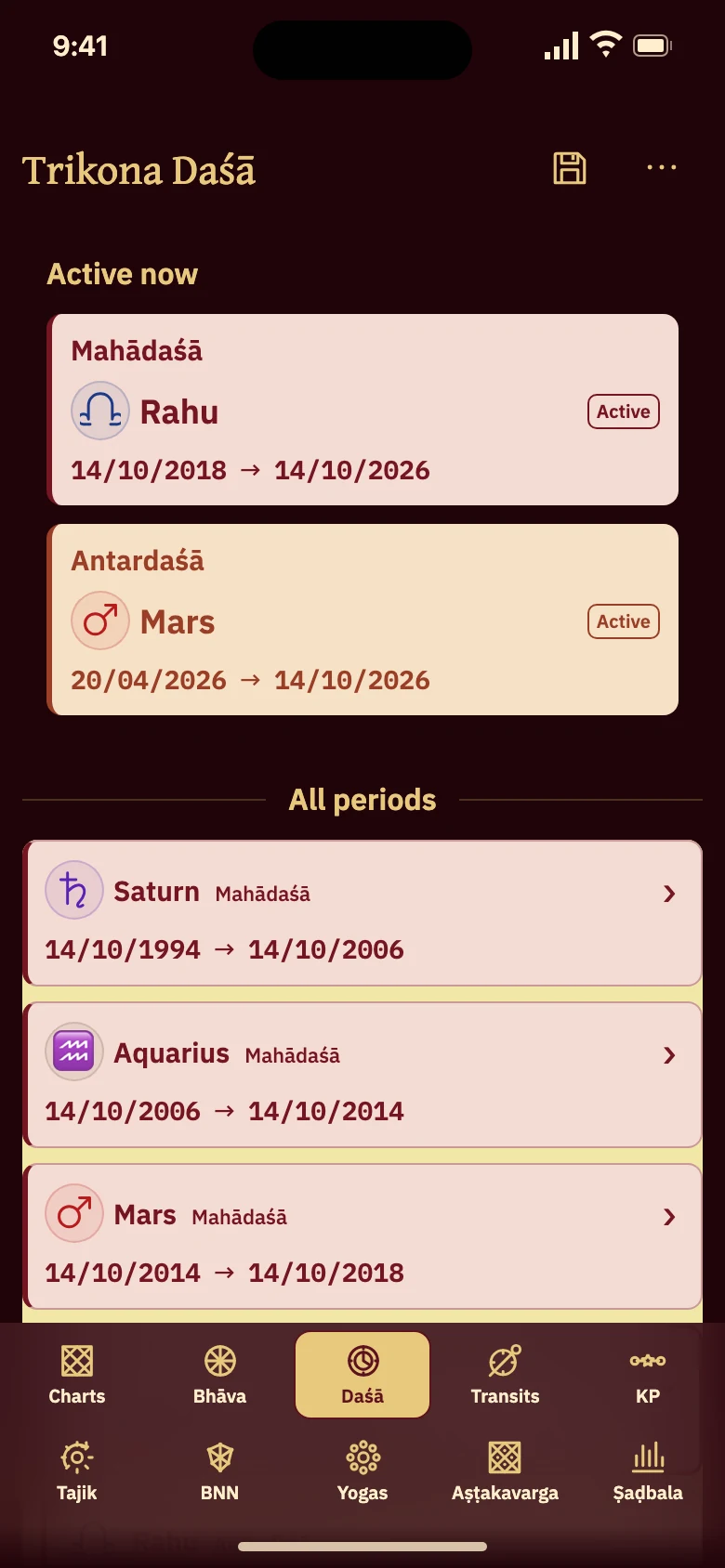
Open the Trikona period list
On a saved chart, enter Daśā, open its options and select Experimental, then Trikona. The real reader places the active intervals above an expandable period list. The preview demonstrates those controls with Nila’s prepared chart.
Note: Trikona is experimental. The diagram presents the existing saved sign sequence and the screenshot retains the reader’s displayed labels. Keep the method and dates with your notes when comparing views or discussing an interval with another reader.
Questions about Trikoṇa Daśā
Where do I select Trikona?
In your chart’s Daśā options, choose Experimental and then Trikona.
Why are Libra, Aquarius and Gemini together?
Those are the first three signs in this saved example, forming a trinal grouping. The page shows that sequence rather than deriving a new one.
Are all its sign periods the same length?
No. This sample begins with twelve, eight and four years. The timeline uses the recorded intervals to show their different lengths.
Is this the same as a personal prediction?
No. It is a fixed example of an experimental timing view. Its dates do not guarantee an event in your own life.
Explore Trikoṇa Daśā on your chart
This real walkthrough opens Experimental and selects Trikona on Nila Raman’s fixed chart. It preserves the app’s displayed labels and periods; visitors cannot enter their own birth details here.
Open your charts