
Ṣaṭtriṁśa Sama Daśā follows a 36-year cycle
Ṣaṭtriṁśa Sama Daśā spans 36 years, with eight planetary allocations increasing from one to eight years; Ketu is excluded. Mạghā labels it Shattrimsa Sama. Its order differs from Yoginī despite the equal cycle length.
Bars use the saved duration in days: Venus 7 years, Rahu 8 years, Moon 1 years, Sun 2 years, Jupiter 3 years, Mars 4 years, Mercury 5 years, Saturn 6 years. The birth marker is 14 October 1994. This chart runs from 1994-04-20 to 2030-04-20.
Birth marker · 14 Oct 1994
- 01Venus20 Apr 1994 →
20 Apr 2001 - 02Rahu20 Apr 2001 →
20 Apr 2009 - 03Moon20 Apr 2009 →
20 Apr 2010 - 04Sun20 Apr 2010 →
20 Apr 2012 - 05Jupiter20 Apr 2012 →
20 Apr 2015 - 06Mars20 Apr 2015 →
21 Apr 2019 - 07Mercury21 Apr 2019 →
20 Apr 2024 - 08Saturn20 Apr 2024 →
20 Apr 2030
Widths follow the saved duration in days. Dates are shown in UTC. Gold marks the current period.
Nila's saved cycle starts with Venus
Nila's prepared schedule begins with Venus in April 1994, before her birth that October. Rāhu follows in April 2001, then the Moon, Sun, Jupiter, Mars and Mercury. Saturn is the last major period in the illustrated cycle, from 20 April 2024 to 20 April 2030.
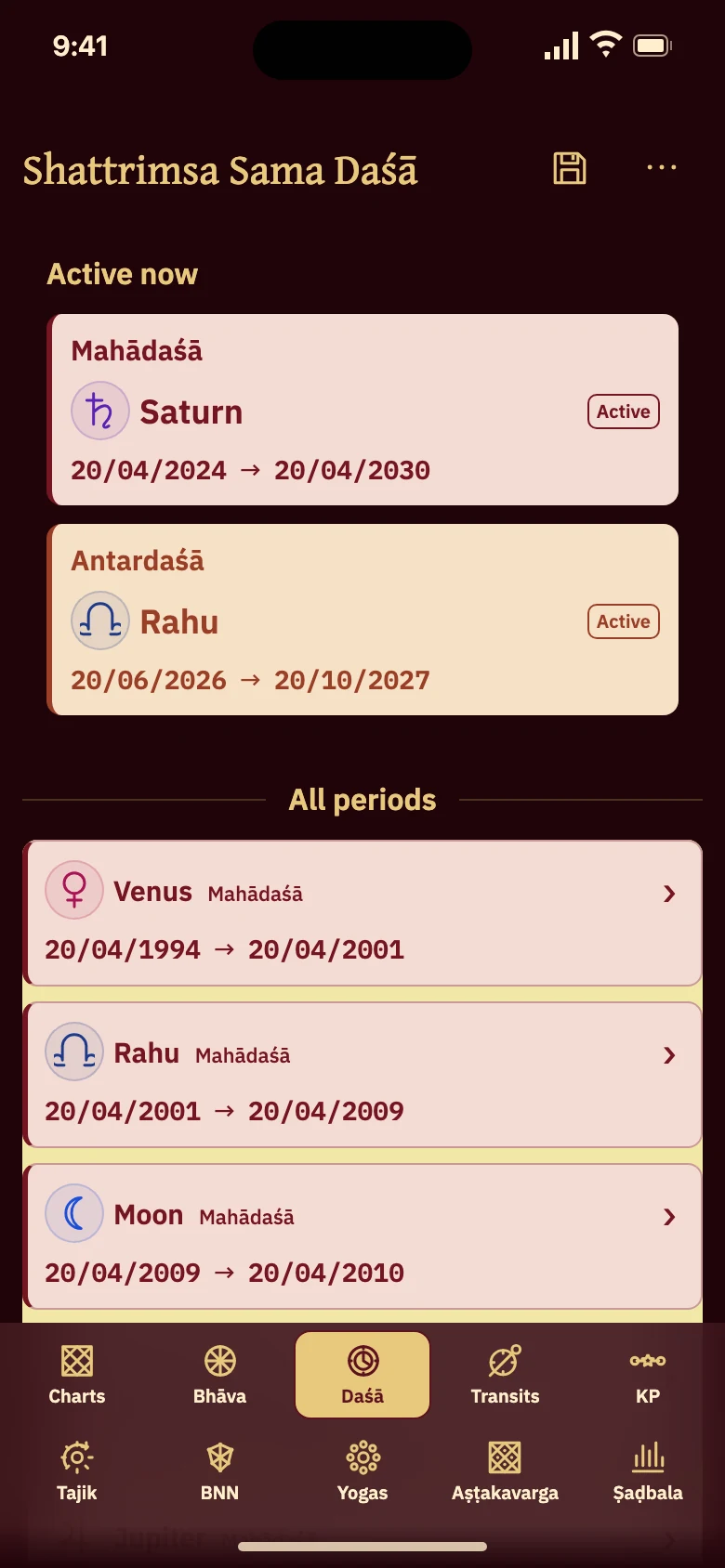
On 12 September 2026, the sample's fixed reference date, Rāhu is the antardaśā lord within that Saturn period. The displayed Rāhu row runs from 20 June 2026 to 20 October 2027. Saturn remains the enclosing major lord throughout this shorter span.
The widths in the diagram come from the saved durations in days. They show the difference between a one-year Moon period and an eight-year Rāhu period without flattening them into equal blocks. The diagram includes one recorded cycle and its birth marker; it does not extend the sample beyond April 2030.
Keep its horā condition separate from the period list
Parāśara associates this system with a day birth whose ascendant falls in the Sun's horā, or a night birth whose ascendant falls in the Moon's horā. In this description, horā is a chart division; it is not simply the hour shown on a clock.
Treat the applicability rule as a separate question from the dates in a prepared list. Establish the tradition and birth-chart settings you are following before choosing the method. A system can be available in a selector without that selection itself being an assessment of your chart.
When comparing Ṣaṭtriṁśa Sama with Yoginī, first confirm the method name, then the enclosing major lord, then the sub-period. In the saved examples the former opens with Venus and the latter with the Moon, so a shared thirty-six-year total does not make their rows interchangeable.

Find Shattrimsa Sama in the system picker
Choose Shattrimsa Sama under Graha Daśās. The phone walkthrough opens at Antardaśā depth, showing Saturn/Rāhu current and the full sequence beginning with Venus. Options extend through Pratyantardaśā and Sūkṣma. The saved Lahiri sample stays at its September 2026 reference moment. For personal use, check birth inputs, settings and the traditional day/night horā condition; this prepared demonstration does not assess eligibility.
Questions about Ṣaṭtriṁśa Sama Daśā
Is Ṣaṭtriṁśa Sama the same as Yoginī Daśā?
They share a 36-year total and the one-to-eight-year planetary allocations, but they are separate selections with different starting rules. In the saved examples, Ṣaṭtriṁśa Sama begins with Venus and Yoginī with the Moon. Keep each method's dates with its own name when comparing them.
Does Sama mean every displayed period is equal?
The prepared schedule displayed here has one-to-eight-year allocations, rather than eight identical spans. Its timeline shows those saved durations directly. Read the period dates and the method name together; the guide does not replace the app's prepared output with a different schedule inferred from the title.
What does Shattrimsa Sama mean in the app menu?
It is the ASCII catalogue spelling for the system called Ṣaṭtriṁśa Sama Daśā in this guide. Choose it under Graha Daśās and check the heading after selection. It has its own period tree, even though another available method, Yoginī, also has a 36-year cycle.
Can I see the Rāhu antardaśā inside Saturn?
Yes. The real sample preview opens with Saturn as the major lord and Rāhu as the sub-period lord on 12 September 2026. Rāhu's displayed row runs from June 2026 to October 2027 within Saturn's April 2024 to April 2030 period. The sample does not accept personal birth details.
Open your Ṣaṭtriṁśa Sama Daśā periods
Read your own major periods and the dated sub-periods inside them. Ṣaṭtriṁśa Sama Daśā is free for life, like every astrology feature in Mạghā.
Open your charts