


Kāraka Daśā follows the chart’s planetary roles
Kāraka Daśā follows the planets in Chara Kāraka order, beginning with the Ātmakāraka. Unlike Vimśottarī's fixed sequence, these roles depend on the chart. Mạghā offers Karaka under Experimental, with dated main periods and subdivisions.
Saved main periods for Nila Raman’s chart at 12 September 2026. All 8 main periods are shown with their recorded lengths. The birth marker and current highlight follow the saved fixture.
Birth marker · 14 Oct 1994
- 01Sun1 Jan 1977 →
1 Jan 1997 - 02Moon1 Jan 1997 →
1 Jan 2015 - 03Venus1 Jan 2015 →
2 Jan 2032 - 04Jupiter2 Jan 2032 →
2 Jan 2048 - 05Saturn2 Jan 2048 →
2 Jan 2060 - 06Mars2 Jan 2060 →
1 Jan 2070 - 07Mercury1 Jan 2070 →
1 Jan 2077 - 08Rahu1 Jan 2077 →
2 Jan 2083
Widths follow the saved duration in days. Dates are shown in UTC. Gold marks the current period.
The saved order begins with the Sun
Nila’s stored sequence runs Sun, Moon, Venus, Jupiter, Saturn, Mars, Mercury and Rāhu. The first main period begins in January 1977, before her birth. The Moon follows in January 1997, then Venus in January 2015.
Venus runs to January 2032, so it contains the sample’s September 2026 reference date. The timeline draws all eight saved main periods from the fixture’s recorded days, with the birth marker inside the Sun’s bar. These lengths describe this supplied result; the diagram does not derive a separate rule for assigning kāraka years.

Read the role alongside the planet
Before interpreting a Kāraka period, identify the planet and the role it holds in the chart. The Jaimini Kārakas guide explains the role list, including the Ātmakāraka and Dārakāraka. A role is a way of reading a planet, not a replacement for its placement in the chart.
For Nila, the Sun heads the saved order, followed by the Moon and Venus. This makes the diagram useful for following the sequence, but it does not establish that every chart begins with the Sun. The chart’s own kāraka order matters.
Kāraka Daśā and Kāraka Kendrādi are separate menu options. Select Karaka for the period list demonstrated here, then keep that system’s dates attached to it when comparing other daśās.

Choose Karaka in the Experimental group
On a saved chart, open the Daśā options, choose Experimental and select Karaka. The phone view places the active main period and sub-period above the expandable dated rows. The real preview shows that selection on the unchanged Nila sample.
Experimental in Mạghā marks this as a study option without certifying every duration rule against every school. The walkthrough demonstrates the period screen. It does not demonstrate a switch between seven- and eight-kāraka schemes for the daśā calculation.
Note: The timeline reproduces the supplied Kāraka dates and lengths; it is not an independent verification of how years should be assigned to each role.
Questions about Kāraka Daśā
Does every Kāraka sequence start with the Sun?
No. The Sun begins Nila’s saved sequence because of her chart’s kāraka order. Kāraka Daśā follows the chart’s planetary roles rather than a universal Sun-first sequence.
Is Karaka the same option as Karaka Kendradhi?
No. They are separate entries in the app. Choose Karaka under Experimental for the screen shown on this page.
Where can I learn the kāraka roles?
The Jaimini Kārakas guide explains the role list and its chart display. Use it alongside the selected daśā rather than treating the role labels as predictions by themselves.
Choose Kāraka Daśā on your chart
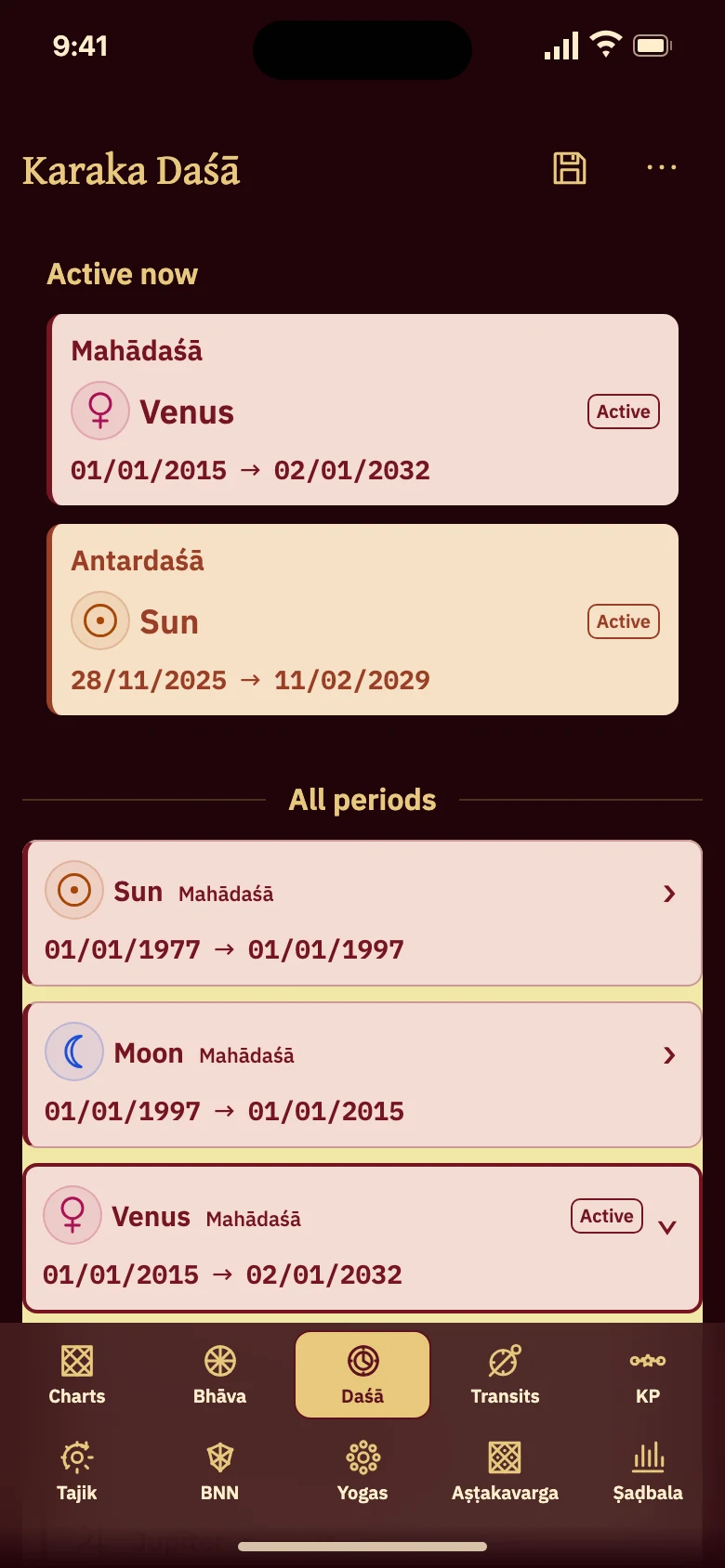
Open Karaka on a chart you save in Mạghā. Astrology features are free for life. This phone-layout preview, also used on desktop, selects the real system on Nila Raman’s chart at a fixed date.
Open your daśā periods