

Navāṁśa Daśā
Navāṁśa Daśā is a sign-based timing system associated with Navāṁśa study. D9 shows placements; this daśā shows dated intervals. Mạghā lists Navamsa under Rāśi and Other Daśās as a separate view from the divisional chart.

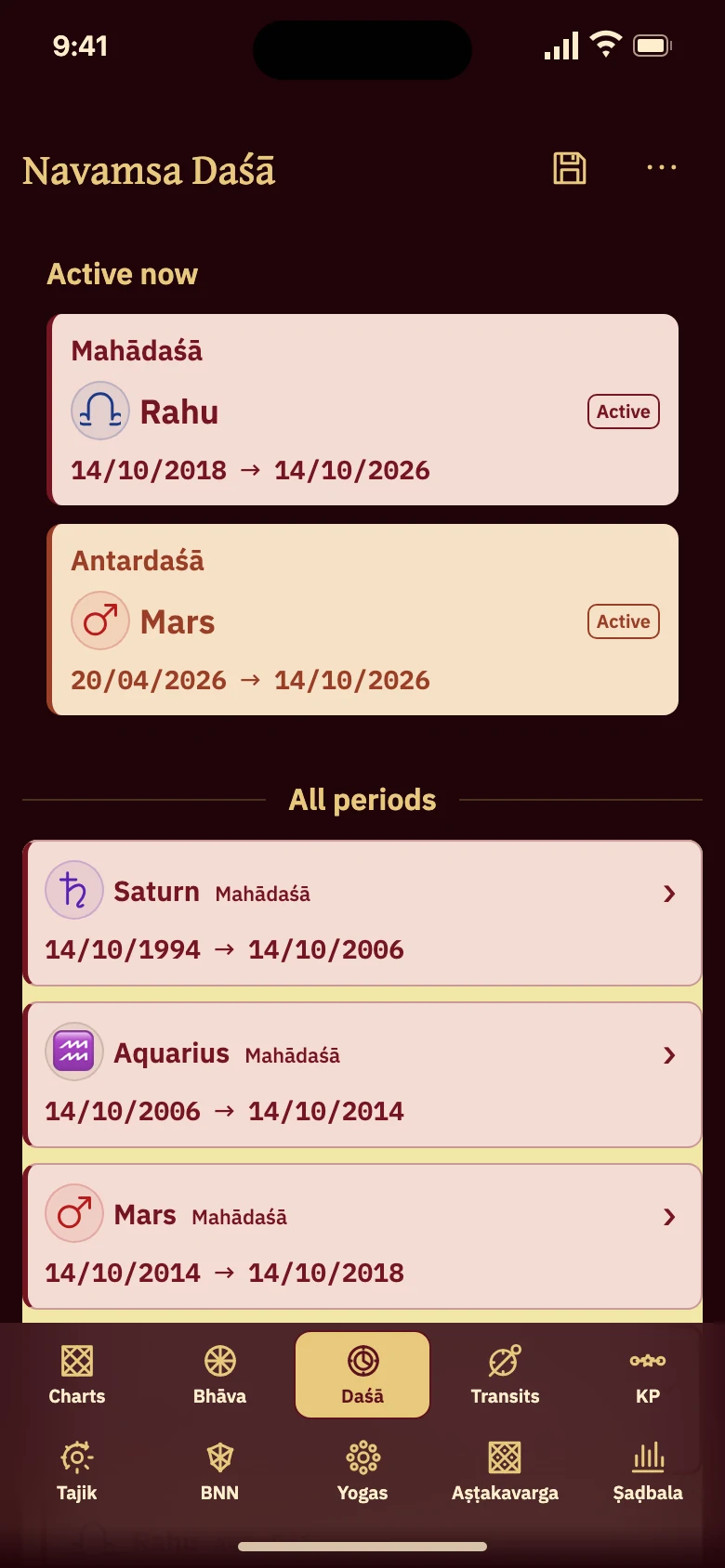
Nila Raman’s chart. Libra, 12 years, 1994-10-14 to 2006-10-14; Aquarius, 8 years, 2006-10-14 to 2014-10-14; Gemini, 4 years, 2014-10-14 to 2018-10-14; Scorpio, 8 years, 2018-10-14 to 2026-10-14; Pisces, 7 years, 2026-10-14 to 2033-10-14; Cancer, 6 years, 2033-10-14 to 2039-10-14; Sagittarius, 10 years, 2039-10-14 to 2049-10-14; Aries, 3 years, 2049-10-14 to 2052-10-13; Leo, 1 year, 2052-10-13 to 2053-10-14; Capricorn, 1 year, 2053-10-14 to 2054-10-14; Taurus, 5 years, 2054-10-14 to 2059-10-14; Virgo, 1 year, 2059-10-14 to 2060-10-13. Dates are the saved fixture’s UTC calendar dates. The diagram uses saved sign display names and does not perform a new calculation.
Birth marker · 14 Oct 1994
- 01Libra14 Oct 1994 →
14 Oct 2006 - 02Aquarius14 Oct 2006 →
14 Oct 2014 - 03Gemini14 Oct 2014 →
14 Oct 2018 - 04Scorpio14 Oct 2018 →
14 Oct 2026 - 05Pisces14 Oct 2026 →
14 Oct 2033 - 06Cancer14 Oct 2033 →
14 Oct 2039 - 07Sagittarius14 Oct 2039 →
14 Oct 2049 - 08Aries14 Oct 2049 →
13 Oct 2052 - 09Leo13 Oct 2052 →
14 Oct 2053 - 10Capricorn14 Oct 2053 →
14 Oct 2054 - 11Taurus14 Oct 2054 →
14 Oct 2059 - 12Virgo14 Oct 2059 →
13 Oct 2060
Widths follow the saved duration in days. Dates are shown in UTC. Gold marks the current period.
Libra, Aquarius and Gemini begin the saved timeline
The sample opens with Libra for twelve years, Aquarius for eight and Gemini for four. Scorpio follows for eight years, then Pisces for seven. These are the stored fixture values; the first twelve main periods span 66 sidereal years.
Scorpio is highlighted at the saved reference instant of 12 September 2026, within its October 2018 to October 2026 interval. The diagram uses the stored sign display names and exact sequence. It is a saved period illustration, not a fresh D9 chart calculation or an independently reconstructed rule.

Keep Navāṁśa placements beside the timing question
Use the period view to identify an interval, and the chart to study what a sign contains and how it relates to the rest of the chart. Expanding a period can help you follow a narrower span, but it does not turn an interpretation into a promised event.
Birth time and calculation settings matter when working with a divisional reference. If you compare another system or program, carry the same chart details into that comparison and check the opening sign, order and dates. Do not infer that a matching feature name guarantees identical methods.

Select Navamsa in the Daśā view
Open a saved chart, enter Daśā and choose its options menu. Under Rāśi and Other Daśās, select Navamsa. This changes the selected period system; to study the D9 chart itself, use the chart’s divisional-chart view.
The preview shows the actual prepared Navamsa period screen for Nila’s chart. The diagram’s sign labels come from the saved fixture, while the app capture retains its own labels and presentation. Both show their real source data without generating a visitor’s personal result.
Questions about Navāṁśa Daśā
Is Navāṁśa Daśā the same as the Navāṁśa chart?
No. The D9 chart is a chart of placements. Navamsa in the Daśā picker is a timing system with a dated sequence of periods.
Which signs open this example?
The stored sequence starts with Libra, Aquarius and Gemini, lasting twelve, eight and four years respectively. The diagram preserves those saved sample values.
Does the highlighted period update every day?
The diagram uses the fixed reference instant recorded with its fixture, 12 September 2026. Read that saved example in its stated context rather than treating its highlight as a live forecast.
Explore Navāṁśa Daśā on your chart

This genuine preview opens Navamsa on Nila Raman’s prepared chart. To read your own periods, open the intended saved chart in Mạghā and choose the same system.
Open Navāṁśa Daśā in Mạghā