
Your Hindu calendar
The Hindu calendar follows local sunrise alongside solar and lunar measures. Mạghā shows the day's calendar information, era years, lunar months and reference checks. Select your city and date to read the corresponding almanac rather than a fixed timetable.
The South Indian 60-year cycle names 2026–27 Parābhava
Each year of the 60-year cycle has a name, from Prabhava, the first, to Akṣaya, the sixtieth. Mạghā follows the South Indian count and, as Tamil almanacs do, starts each year at Meṣa Saṅkrānti, when the Sun enters sidereal Aries. On the sample day it showed Parābhava, the 40th name, which began at 09:32 on 14 April 2026 and runs to 14 April 2027.
Telugu, Kannada and Marathi almanacs begin the same year at Ugādi or Gudi Padwa, the first day of Chaitra's bright fortnight, which fell on 19 March 2026. North Indian almanacs keep the older count tied to Jupiter's mean motion, which drops one name about every 85 years, so their count moved from Siddhārthī to Raudra in April 2026.
The era years put September 2026 in Vikram Samvat 2083
The Calendar eras card gives three year counts. Vikram Samvat, the era traditionally linked to King Vikramāditya, stood at 2083 on the sample day. The Śaka era, which India's national calendar also uses, stood at 1948, and the Kali Yuga count at 5127, the years elapsed since its traditional start in 3102 BCE.
Mạghā advances all three on 22 March, or 21 March in a leap year, the first day of the national calendar's year; most lunisolar almanacs advance them at Ugādi. The Vikram Samvat shown is the northern count, which begins in Chaitra. Gujarat starts its Vikram Samvat on the first day of Kārtika's bright fortnight, just after Dīpāvalī, so Gujarati almanacs showed 2082 on the sample day and turn to 2083 on 10 November 2026.
The amānta Bhādrapada runs from the new moon at 08:57 on 11 September to the new moon at 21:20 on 10 October. The pūrṇimānta Bhādrapada runs from the full moon at 09:48 on 28 August to the full moon at 22:19 on 26 September, after which it becomes Āśvina while the amānta month stays Bhādrapada.
28 August 202610 October 2026
- Amānta
- Śrāvaṇa · until 11 September
- Bhādrapada · 11 September–10 October
- Pūrṇimānta
- Bhādrapada · 28 August–26 September
- Āśvina · from 26 September
| Boundary | Date | Time · IST |
|---|---|---|
| Full moon | 28 August | 09:48 |
| New moon | 11 September | 08:57 |
| Full moon | 26 September | 22:19 |
| New moon | 10 October | 21:20 |
Two reckonings end the month at different moons
Amānta months run new moon to new moon; pūrṇimānta months run full moon to full moon. Their bright-fortnight names agree, while dark-fortnight names differ. The sample reads Bhādrapada in both; pūrṇimānta changes at 26 September's full moon, amānta at 10 October's new moon.
Without a saṅkrānti between new moons, an adhika month precedes its nija counterpart. Mạghā can miss amānta's first leap-month day, and its pūrṇimānta labeling is unreliable around leap months.
Dakṣiṇāyana runs from Karka Saṅkrānti to Makara Saṅkrānti
The sidereal convention begins Uttarāyaṇa at Makara Saṅkrānti and Dakṣiṇāyana at Karka Saṅkrānti, now 24–25 days after the solstices. Mạghā determines ayana from the sunrise Sun. Its six-season card starts Vasanta at Meṣa Saṅkrānti, later than the Sūrya Siddhānta's two-sign seasons counted from Śiśira at Makara. Lunar-month pairings also differ. The sample day reads Dakṣiṇāyana and Varṣā under all three seasonal comparisons.
The Sun rose at 06:12, crossed the meridian at 12:15 and set at 18:19, giving 12 hours 7 minutes of daylight. The Moon rose at 06:58, less than a day past new, and set at 19:19.
05:30 IST20:00 IST
- Sun
- Sunrise 06:12:09 → sunset 18:19:37
- Moon
- Moonrise 06:58:58 → moonset 19:19:02
On the sample day the Moon rose three quarters of an hour after the Sun
Sky & calendar gives the first moonrise and moonset after sunrise, daylight length, and the Sun's reference-time sign/nakṣatra/pada. The Bengaluru sample has sunrise 06:12, moonrise just before 07:00, sunset 18:19 and moonset 19:19, with 12 hours 7 minutes of daylight.
Mạghā uses the disc centre without refraction, and omits lunar latitude and parallax here. Moonrise/set can differ by several minutes from astronomical tables; sample moonset differs by about nine minutes.
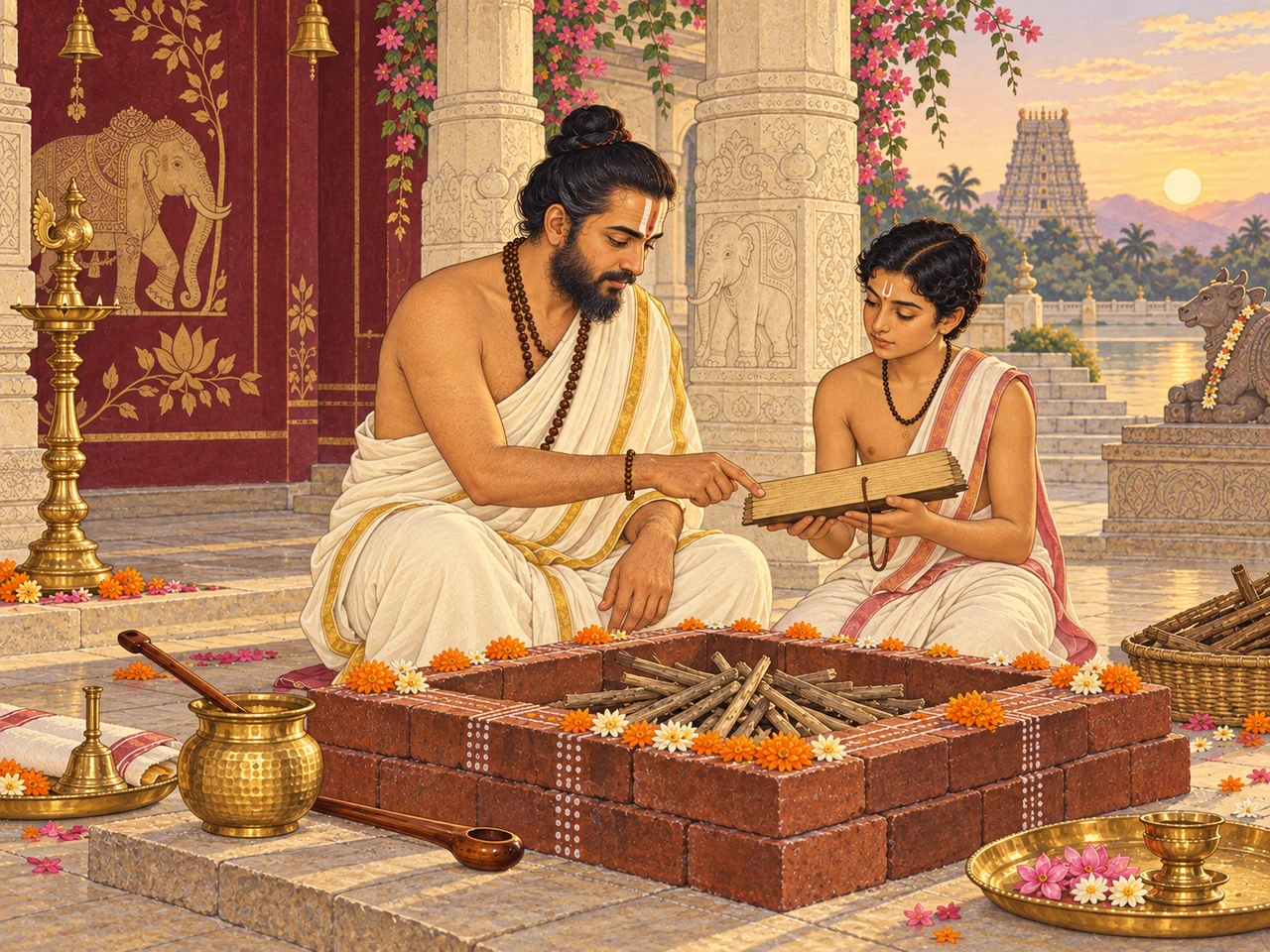
Agni Vāsa and Śiva Vāsa tell a priest whether today suits a rite
Vasa, Homa & Shula combines six traditional checks. Agni Vāsa uses tithi/weekday for the fire's residence; Homa Ahuti labels its suitability, although some almanacs use that name for a receiving planet instead. Śiva Vāsa uses tithi for Rudrābhiṣeka. Diśā Śūla gives a weekday travel caution, Nakṣatra Śūla a star-based direction, and Rāhu Vāsa the weekday's attributed residence. Tables vary. The sample has Agni in the netherworld, Śiva with Gaurī, east Diśā Śūla and north Nakṣatra Śūla.
The nakṣatra card describes the Moon's star in eight traditional terms
The last card takes its title from the Moon's nakṣatra at the reference time and lists eight attributes: deity, symbol, ruling planet, gaṇa (temperament: divine, human or demonic), yoni (animal), nāḍī (Vāta, Pitta or Kapha), guṇa and tattva (element). At noon on the sample day it was Uttara Phalgunī: deity Aryaman, symbol a bed, lord the Sun, Manuṣya gaṇa, cow yoni, Vāta nāḍī, rajas guṇa and the fire element.
Gaṇa, yoni and nāḍī are three of the factors scored in horoscope matching, so the card works as a quick reference. Set a later reference time and the card follows the Moon: on the sample day Hasta took over at 12:55.
The month, year and season follow local sunrise
Sky & calendar and Traditional day references follow the selected Pañchāṅga date. Month, saṁvatsara, ayana and ṛtu use local sunrise with Swiss Ephemeris/Lahiri; pakṣa, solar position, vāsa and star-based entries use the reference time. The page covers one day without festival, ekādaśī or eclipse calendars.
Mạghā starts saṁvatsara at Meṣa Saṅkrānti and era years on 22 March. Spring labels can therefore differ from Ugādi or Gudi Padwa almanacs for about a month.
What people ask about the Hindu calendar
Which Hindu month is going on now?
It depends on the reckoning and the fortnight. In the bright half both reckonings give the same month; in the dark half the pūrṇimānta month runs one ahead. On 12 September 2026 both gave Bhādrapada. From 27 September pūrṇimānta almanacs moved to Āśvina, and amānta ones followed after the new moon of 10 October. Mạghā's Sky & calendar card shows the amānta month for any date, and Traditional day references shows both.
What is the saṁvatsara name for 2026?
Parābhava, the 40th year of the 60-year cycle, in South Indian almanacs. Telugu, Kannada and Marathi almanacs began it at Ugādi or Gudi Padwa on 19 March 2026; Tamil almanacs, and Mạghā, at Meṣa Saṅkrānti on 14 April. It lasts until the same point in 2027. North Indian almanacs follow a Jupiter-based count, which moved from Siddhārthī to Raudra in April 2026.
Which month is Adhik Maas in 2026?
Jyeṣṭha. No saṅkrānti fell between the new moons of 17 May and 15 June 2026, so that lunar month became Adhika Jyeṣṭha, with the regular Nija Jyeṣṭha after it. A leap month comes about once every 32 to 33 months. Mạghā's amānta label shows the prefix, for example Adhika Jyeshtha on 24 May and Nija Jyeshtha on 16 June 2026.
What is Vikram Samvat 2083?
It is the Vikram Samvat year that began in North India on 19 March 2026, the first day of Chaitra's bright fortnight, and runs until the same point in 2027. Gujarat begins its 2083 later, on 10 November 2026, just after Dīpāvalī. Mạghā shows Vikram Samvat 2083 from 22 March 2026, alongside Śaka 1948 and Kali 5127.
See today's Hindu calendar for your city

Bengaluru, India · Asia/Kolkata
The almanac is part of Mạghā's free public Pañchāṅga page and needs no account. The preview opens Sky & calendar and Traditional day references for the fixed sample, Bengaluru on 12 September 2026.
See today's Hindu calendar