
Vimśottarī Daśā
Vimśottarī Daśā divides 120 years among nine planetary lords. Your birth Moon's nakṣatra sets the first lord, and its remaining portion sets the opening balance. Mạghā shows dated periods through four levels, down to Sūkṣma.
Bars are sized by length: Mars 7 years (begun before birth), Rāhu 18, Jupiter 16 (current, April 2019 to April 2035), Saturn 19, Mercury 17, Ketu 7, Venus 20, Sun 6 and Moon 10, ending in April 2114.
Birth marker · 14 Oct 1994
- 01Mars20 Apr 1994 →
20 Apr 2001 - 02Rahu20 Apr 2001 →
21 Apr 2019 - 03Jupiter21 Apr 2019 →
21 Apr 2035 - 04Saturn21 Apr 2035 →
20 Apr 2054 - 05Mercury20 Apr 2054 →
21 Apr 2071 - 06Ketu21 Apr 2071 →
21 Apr 2078 - 07Venus21 Apr 2078 →
21 Apr 2098 - 08Sun21 Apr 2098 →
21 Apr 2104 - 09Moon21 Apr 2104 →
22 Apr 2114
Widths follow the saved duration in days. Dates are shown in UTC. Gold marks the current period.
Your Moon's nakṣatra picks the first period
From Aśvinī, the repeating order is Ketu 7, Venus 20, Sun 6, Moon 10, Mars 7, Rāhu 18, Jupiter 16, Saturn 19 and Mercury 17 years: 120 total. The Moon's elapsed share of its nakṣatra sets elapsed years before birth. Nila's Moon is about 7% through Mars-ruled Dhaniṣṭhā, leaving roughly 6½ years. Rāhu follows in April 2001 and Jupiter in April 2019; the cycle ends April 2114.
Parāśara judges each period by its lord
Parāśara calls Vimśottarī the principal system and judges each period through its lord's nature, placement and strength. Favorable dignity or an ascendant placement supports results; debilitation, enemy signs or difficult houses can challenge them. Both birth placements and those at the period's beginning matter. Mahādaśās are read with their sub-periods, described down to Prāṇa, so the same planetary period means different things in different charts.

Explore four period levels
The default Vimśottarī card lists nine mahādaśās, expanding through Antardaśā, Pratyantardaśā and Sūkṣma. Every row has start and end dates; the options menu selects another system.
Mạghā uses 365.2564-day sidereal years and your selected ayanāṁśa, Lahiri by default.
Note: birth-time uncertainty shifts the Moon and every period boundary. In Nila’s example, one hour changes the dates by roughly 100 days.
Each bar is Jupiter's 16 years times its antardaśā lord's years divided by 120, from Venus at 2.67 years down to the Sun at 0.8 years. Ketu, the current sub-period, runs from late March 2026 to early March 2027.
- 01Jupiter21 Apr 2019 →
8 Jun 2021 - 02Saturn8 Jun 2021 →
20 Dec 2023 - 03Mercury20 Dec 2023 →
27 Mar 2026 - 04Ketu27 Mar 2026 →
3 Mar 2027 - 05Venus3 Mar 2027 →
1 Nov 2029 - 06Sun1 Nov 2029 →
20 Aug 2030 - 07Moon20 Aug 2030 →
20 Dec 2031 - 08Mars20 Dec 2031 →
25 Nov 2032 - 09Rahu25 Nov 2032 →
21 Apr 2035
Widths follow the saved duration in days. Dates are shown in UTC. Gold marks the current period.
Nila's Ketu antardaśā runs inside Jupiter until March 2027
On 12 September 2026, the reference date, Nila Raman is in her Jupiter mahādaśā, which runs from April 2019 to April 2035. Its nine antardaśās begin with Jupiter itself and keep the cycle's order: Jupiter, Saturn, Mercury, Ketu, Venus, Sun, Moon, Mars, Rāhu.
Each share is Jupiter's 16 years multiplied by the antardaśā lord's years and divided by 120. Ketu gets 16 × 7 ÷ 120 = 0.93 years, about 341 days, so Nila's Ketu antardaśā runs from late March 2026 to early March 2027. Venus follows with the largest share, 2.67 years, to November 2029.
Following Parāśara's rules, an astrologer would weigh Jupiter's strength and placement at birth and when its period began in April 2019, then Ketu's.
What people ask about Vimśottarī Daśā
How do you calculate Vimśottarī Daśā by hand?
Find the Moon's sidereal longitude and its nakṣatra; that nakṣatra's lord rules the first mahādaśā. Divide the part of the nakṣatra the Moon has still to cross by its full span of 13°20′, and multiply by the lord's years to get the balance at birth.
Then add the other eight lords' full periods in order; with the part that ran before birth, the nine make 120 years. For an antardaśā, multiply the two lords' years and divide by 120.
What is the balance of daśā at birth?
It is the part of the first mahādaśā still to run when you are born. Parāśara multiplies the lord's years by the share of the birth nakṣatra the Moon has already passed through, which he measures in time, and subtracts that from the full period; Mạghā, like most software, measures the share by the Moon's longitude. Nila's Moon had crossed about 7% of Dhaniṣṭhā, so 93% of Mars's 7 years, about six and a half years, remained.
What is the difference between a mahādaśā and an antardaśā?
A mahādaśā is one of the nine major periods, from 6 years for the Sun to 20 for Venus. Each one divides into nine antardaśās, also called bhuktis, in the same proportions, starting with the mahādaśā's own lord. Each antardaśā divides again into pratyantardaśās, and those into sūkṣmas, which divide into prāṇas.
Why do programs show different Vimśottarī dates?
Every date rests on the Moon's position, so the birth time moves them, and so does the ayanāṁśa: changing it shifts the sidereal Moon, and with it the balance at birth. Programs also count years of different lengths. Mạghā uses a sidereal year of 365.2564 days and the ayanāṁśa set in your Calculation defaults.
See your Vimśottarī periods in Mạghā
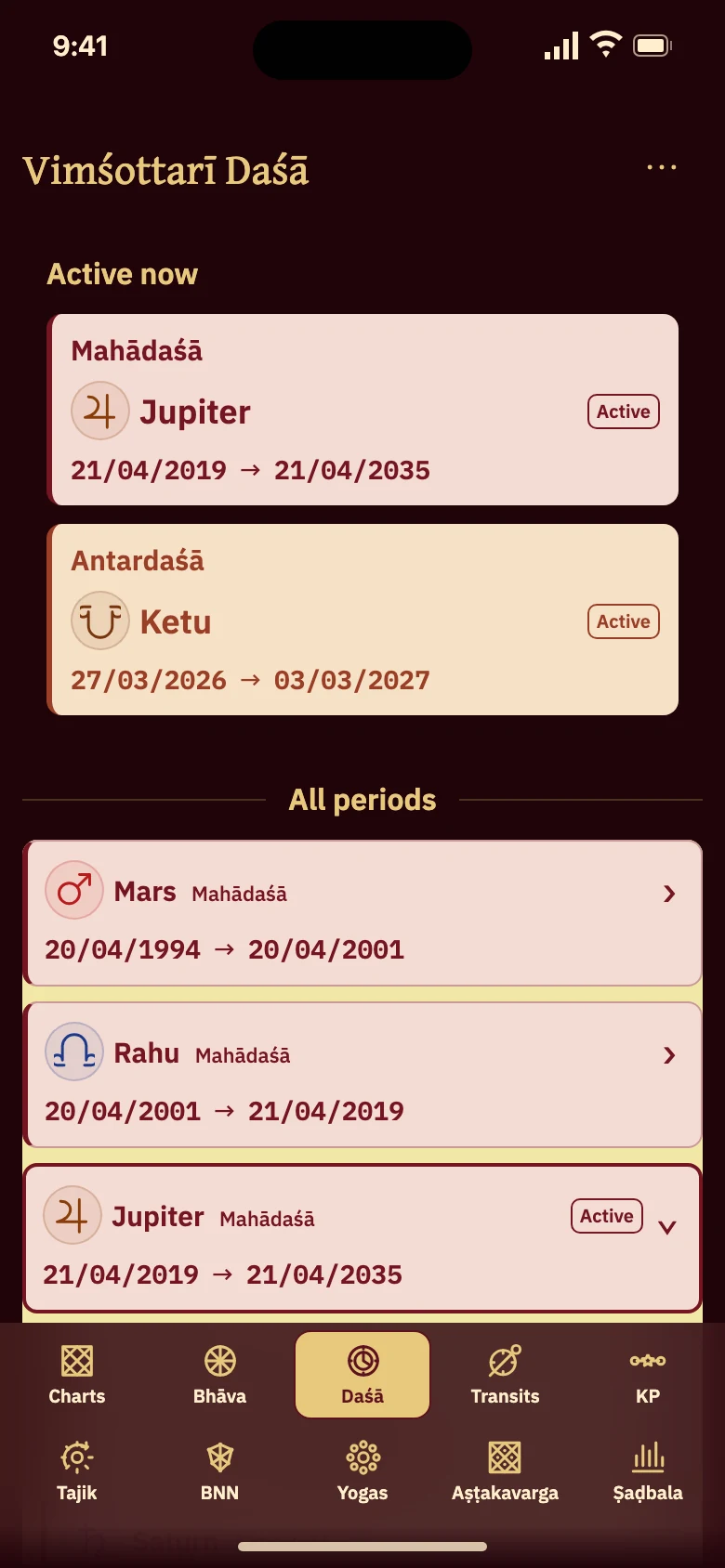
Open your own chart to see all nine of your mahādaśās and the dated sub-periods inside each. Vimśottarī is free for life, like every astrology feature in Mạghā.
Open your charts