


Mudda Daśā brings Vimśottarī into the year
Mudda Daśā adapts Vimśottarī's planetary sequence to annual-chart work. Select it under Annual Daśās in Mạghā and choose the year. Its intervals concern that annual study rather than the full lifetime cycle of Vimśottarī.
Nila Raman. Historical prepared output; UTC calendar dates. Bar widths use saved duration in days. No active-period claim.
Birth marker · 14 Oct 1994
- 01Saturn14 Oct 1994 →
10 Dec 1994 - 02Mercury10 Dec 1994 →
30 Jan 1995 - 03Ketu30 Jan 1995 →
20 Feb 1995 - 04Venus20 Feb 1995 →
21 Apr 1995 - 05Sun21 Apr 1995 →
9 May 1995 - 06Moon9 May 1995 →
8 Jun 1995 - 07Mars8 Jun 1995 →
29 Jun 1995 - 08Rahu29 Jun 1995 →
22 Aug 1995 - 09Jupiter22 Aug 1995 →
9 Oct 1995
Widths follow the saved duration in days. Dates are shown in UTC. Historical prepared output; no active-period claim.
An annual sequence contains short planetary periods
Nila’s saved year-one example starts with Saturn, then Mercury, Ketu and Venus. Their durations are 57, 51, 21 and 60 days. The complete saved sequence has nine major periods; the diagram draws each bar in proportion to its duration in days.
This particular record begins on 14 October 1994. It is a historical prepared example, not a forecast for the current year. Its dates show the UTC calendar dates in the saved output.

Keep the annual context beside the period table
A Mudda period is read within the annual chart being examined. Keep the selected annual year visible when comparing a result, and distinguish its short planetary periods from the much longer natal Vimśottarī periods.
The two tables answer different timing questions. A shared planet name does not make their intervals interchangeable. Use the annual chart and the rest of your reading method to interpret a period; the table itself lists timing, not a guaranteed event.

Select Mudda and check the annual year
In the Daśā reader, open ⋯, choose Annual Daśās, then Mudda. Reopen the options to find Annual year. The year is part of the result’s context, so note it when saving or comparing a reading.
The website walkthrough selects Mudda on the prepared Nila sample. Its saved example is not recalculated from visitor input, and selecting a different system should not be read as changing a saved natal result’s provenance.
Note: This guide describes the available annual reader and its prepared example. It makes no claim that a period predicts an event or matches every annual-chart tradition.
Questions about Mudda Daśā
What is Mudda Dasha?
Mudda is an annual period system that brings the Vimśottarī planetary sequence into an annual-chart context. Its periods are much shorter than the corresponding natal periods.
Is Mudda the same as natal Vimshottari?
No. Both use planetary period names, but Mudda concerns an annual span. Read the annual year and its own dates rather than substituting them for a natal Vimśottarī table.
Where do I choose the annual year?
Select Mudda under Annual Daśās in the Daśā options. The options also expose an Annual year control. Keep that selection with the result you are reading.
Open Mudda Daśā on your saved chart
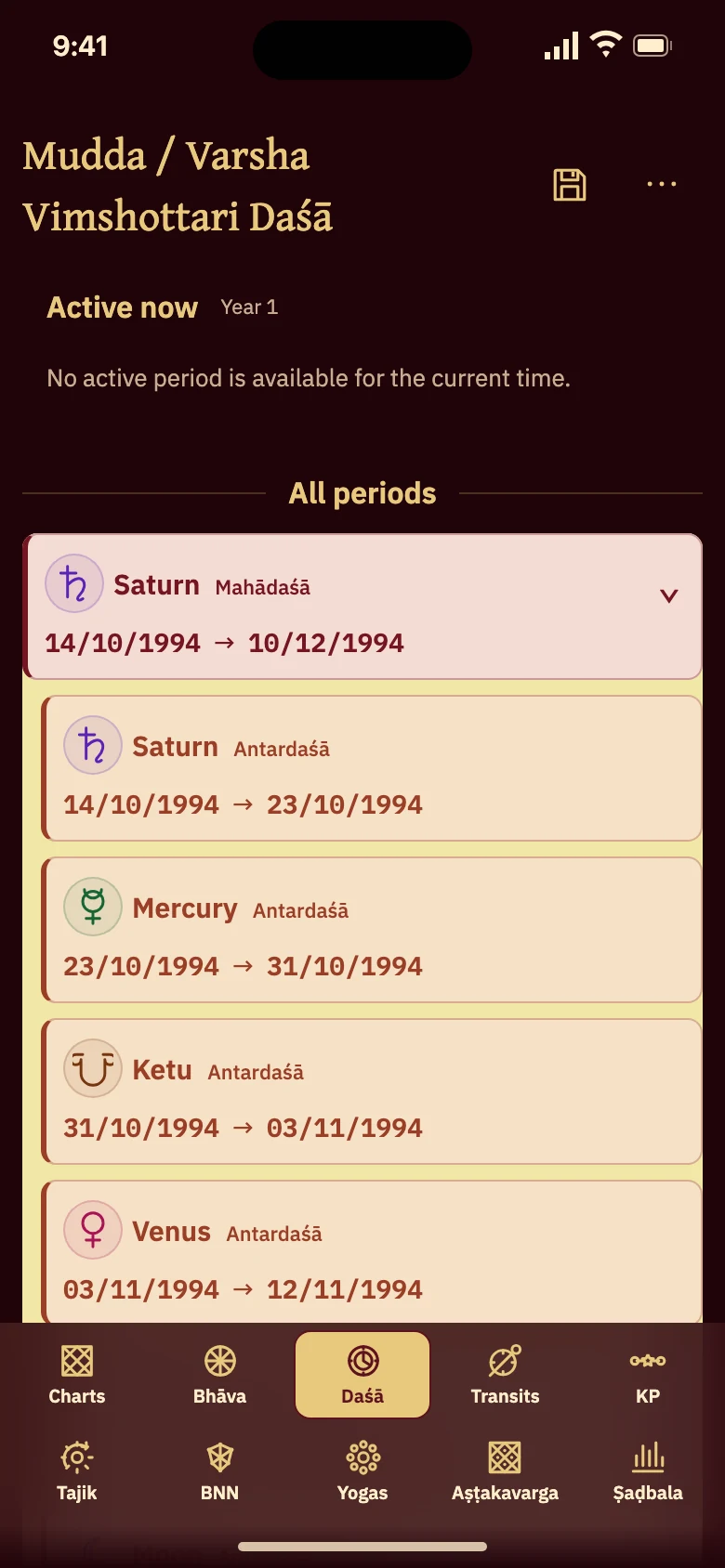
Explore Mudda on your chart. The Nila Raman demo opens its saved Year 1 periods and expands the first main period, Saturn, from 14 October 1994.
Open your charts