
Saptarṣi Nakṣatra Daśā
Saptarṣi Nakṣatra Daśā assigns main periods to lunar mansions. The saved sample runs backward from the Moon's Dhaniṣṭhā, with equal shares of a 100-year cycle. Mạghā lists it under Graha Daśās and supplies dated subdivisions.
Saved main periods for Nila Raman’s chart at 12 September 2026. The first nine of twenty-seven periods are shown, through Swati. The birth marker and current highlight follow the saved fixture.
Birth marker · 14 Oct 1994
- 01Dhanishta12 Jul 1994 →
26 Mar 1998 - 02Shravana26 Mar 1998 →
8 Dec 2001 - 03Uttara Ashadha8 Dec 2001 →
22 Aug 2005 - 04Purva Ashadha22 Aug 2005 →
5 May 2009 - 05Mula5 May 2009 →
17 Jan 2013 - 06Jyeshtha17 Jan 2013 →
1 Oct 2016 - 07Anuradha1 Oct 2016 →
15 Jun 2020 - 08Vishakha15 Jun 2020 →
28 Feb 2024 - 09Swati28 Feb 2024 →
11 Nov 2027
First 9 of 27 saved periods. Widths follow the saved duration in days. Dates are shown in UTC. Gold marks the current period.
Equal periods move backward from the birth star
The saved sequence begins with Dhaniṣṭhā in July 1994, followed by Śravaṇa, Uttara Āṣāḍhā and Pūrva Āṣāḍhā. Each complete main period lasts about 3.70 sidereal years. The first starts before Nila’s birth because the saved result includes the share of her birth nakṣatra already crossed by the Moon.
This diagram shows the first nine of the 27 saved main periods, through Svātī. Svātī runs from February 2024 to November 2027 and contains the sample’s reference date. The remaining eighteen periods continue in the fixture; this shortened view keeps the names legible on a phone.
Read the nakṣatra before comparing the dates
A nakṣatra-led period list asks a different question from a planetary one. Start with the mansion named for the main period, then read it alongside the Moon, its placement and the rest of the birth chart. A matching date in another daśā does not make the two systems interchangeable.
The name Saptarṣi also appears in calendar traditions. This page describes the option and saved sequence supplied by Mạghā; it does not equate this personal period list with a historical Saptarṣi calendar. No classical attribution is needed to follow the controls shown here.
For a planetary comparison, open the Vimśottarī guide. Its nine planetary lords and 120-year cycle provide a useful contrast with this sample’s equal nakṣatra periods.

Choose the system from Graha Daśās
Open a saved chart, find the Daśā card and select its options menu. Under Graha Daśās, the app calls this system Saptharishi Nakshathra. The phone view opens the period list, with its active main period and sub-period above the dated rows.
The preview uses that real control path on Nila’s bundled sample. It selects the system and stops on its prepared result. The app can show numbered labels such as Nakshatra 15; the diagram’s corresponding readable name is Svātī. Visitors cannot replace Nila’s birth details in this embedded sample.
Note: The timeline is a saved example at a fixed date, not a fresh calculation for the visitor or a certification of a particular traditional method.
Questions about Saptarṣi Nakṣatra Daśā
Is this the same as Vimśottarī Daśā?
No. This saved sequence follows 27 nakṣatras with equal main-period lengths. Vimśottarī follows nine planetary lords with unequal lengths. Their labels and dates should be read within their own systems.
Why does the first period begin before birth?
The saved result includes the elapsed part of the Moon’s birth nakṣatra. Nila’s first main period therefore begins in July 1994, before her October birth. The birth marker on the diagram makes that distinction explicit.
Why does the app show a numbered nakṣatra?
The real app can display labels such as Nakshatra 15. This page’s saved-data diagram uses the fixture’s readable name, Svātī, without changing the captured app screen.
Choose Saptarṣi Nakṣatra Daśā on your chart
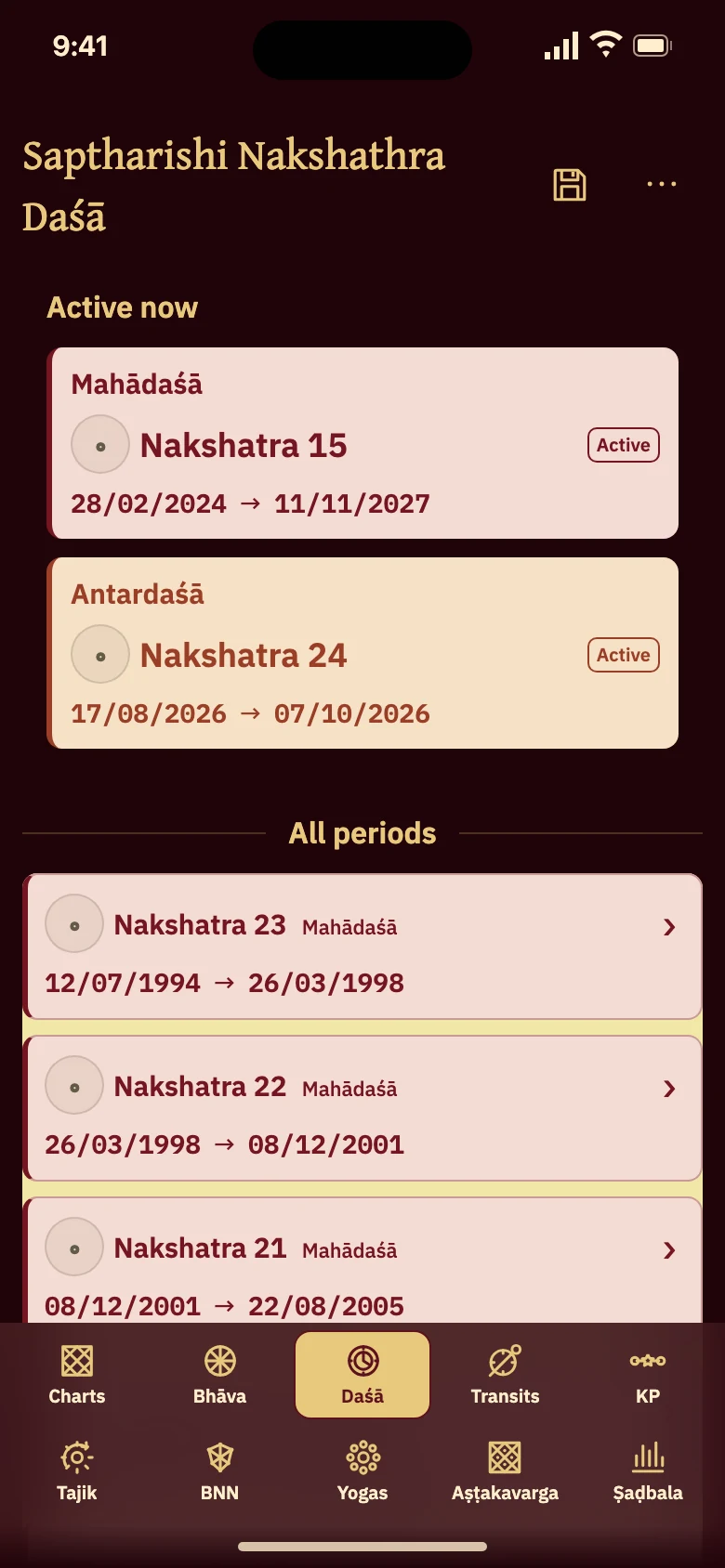
Select Saptharishi Nakshathra on your saved chart. The demo uses a phone layout on all screens and shows Nila Raman's fixed sample.
Open your daśā periods