
Tājika yogas
Tājika yogas describe planets approaching, separating or connecting through other planets. Mạghā shows the detected pairs and explanations in the annual chart. Itthaśāla concerns a faster planet approaching a slower one within the relevant aspect and orb.
Full values and app half-orbs in degrees: Sun 15 and 7.5, Moon 12 and 6, Mars 8 and 4, Mercury 7 and 3.5, Jupiter 9 and 4.5, Venus 7 and 3.5, Saturn 9 and 4.5. Bars use a common zero-to-fifteen-degree scale.
Full value
App half-orb
An aspect needs an orb as well as a sign relationship
Tājika considers the relationship between signs, then how close the planets are within their signs. Deeptāṃśa is the planet-specific orb used in that assessment. The familiar values are 15° for the Sun, 12° for the Moon, 8° for Mars, 7° for Mercury and Venus, and 9° for Jupiter and Saturn.
The prepared app’s yoga checks use half of each listed value. The diagram distinguishes those working half-orbs from the full values, rather than drawing a universal aspect window. Texts and methods can differ in how orbs and application are judged. When comparing readings, keep the method and the chart’s actual degrees in view; a shared yoga name alone does not establish that two calculations use the same rule.
Within-sign degrees, not absolute zodiac distance. Sun at Virgo 26 degrees 40 minutes 23 seconds and Jupiter at Cancer 27 degrees 35 minutes 43 seconds, gap 55 minutes 20 seconds, displayed poorna. Mars at Cancer 14 degrees 59 minutes 7 seconds and retrograde Saturn at Pisces 16 degrees 18 minutes 36 seconds, gap 1 degree 19 minutes 29 seconds, displayed varthamana. These are the app's classifications.
Gap 0°55′20″
Gap 1°19′29″
Inspect the planets behind an Ithasala label
In application, the planet approaching the relationship is still short of the other’s degree; separation describes a relationship already passed. The degree comparison is within the signs, not the absolute distance around the zodiac. The aspect, the motion and the method all matter to the interpretation.
Nila’s expanded Ithasala card lists four pairs. Two are plotted here: Sun–Jupiter, labelled “poorna”, and Mars–Saturn, labelled “varthamana”. The Sun is at Virgo 26°40′23″ and Jupiter at Cancer 27°35′43″; their within-sign gap is 0°55′20″. Mars is at Cancer 14°59′07″ and retrograde Saturn at Pisces 16°18′36″, a gap of 1°19′29″. These labels reproduce the app’s displayed classifications rather than an independent calculation of every traditional condition.
Some yogas connect planets through a third
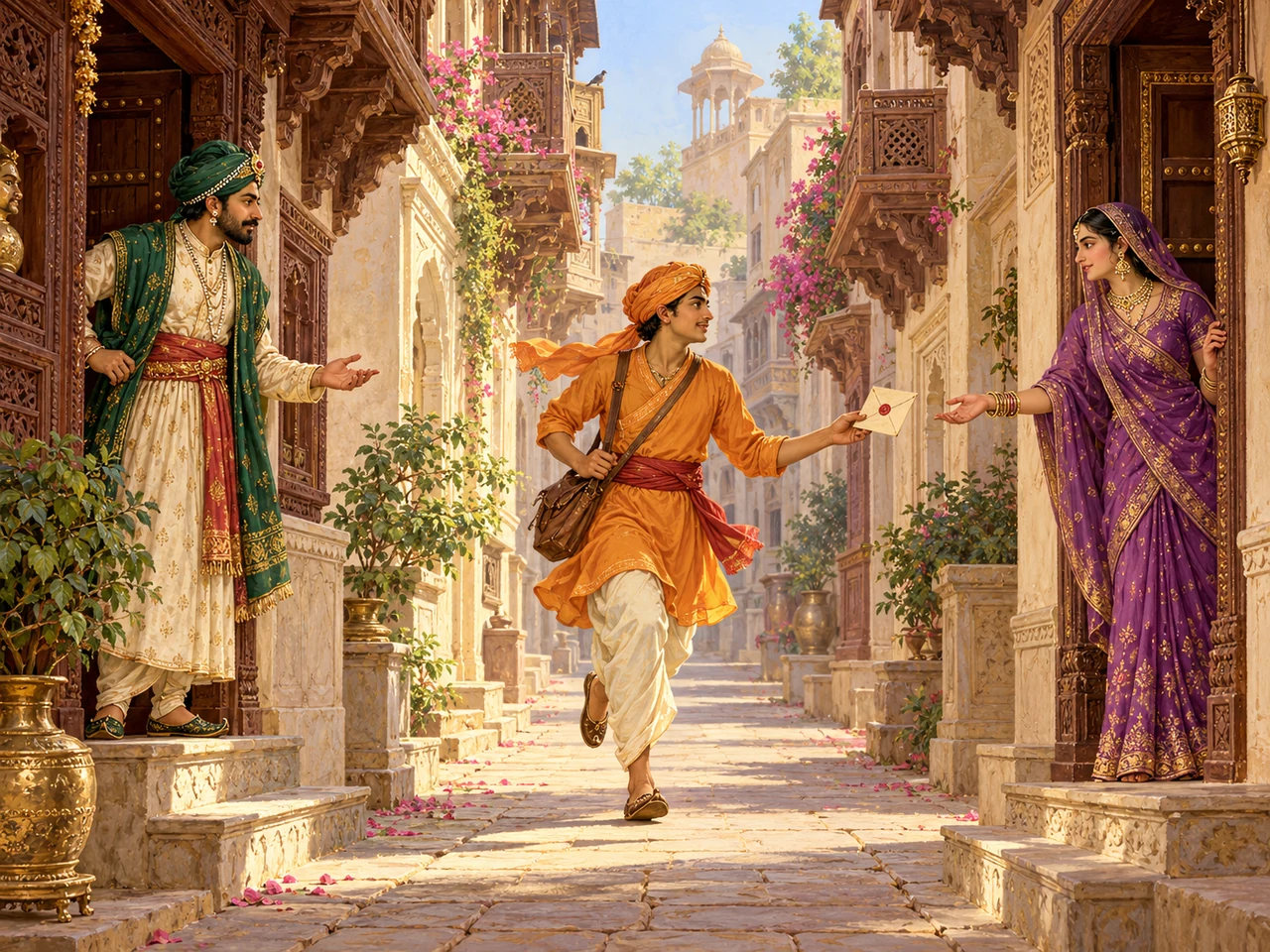
Nakta and Yamayā describe an intermediary connecting two planets. The image of a messenger carrying a letter helps explain the idea of transferring or collecting light: two parties can be connected through another participant. Kambūla brings the Moon into the relationship, while other yoga names describe obstruction, weakness or support.
These are related tests, not mutually exclusive boxes. One pair can appear under more than one card. In the prepared sample, Ithasala has four formations; the present list also includes Manahoo, Kamboola, Radda and Duhphali Kutta. Opening a card reveals its own explanation and relationships. A count is a count of that check’s displayed formations, not a tally of separate future events.
Open the explanation, then read the formations
Choose Tajik in your chart workspace and stay in Annual. Below the glance cards and year-lord comparison, the yoga list shows present formations. Mạghā provides ten checks: Ikkavala, Induvara, Ithasala, Eesarpha, Nakta, Yamaya, Manahoo, Kamboola, Radda and Duhphali Kutta. The interface uses these spellings without Sanskrit diacritics.
Expand Ithasala to read the explanation and its four sample pairs: Sun–Jupiter, Moon–Venus, Mars–Venus and Mars–Saturn. The preview opens this actual card in the prepared 2026 chart. It keeps the app’s explanations and labels visible, so you can see the scope of the feature before opening your own chart. It does not offer fresh calculations, visitor birth entry or a complete implementation of all sixteen traditional yoga names.
Questions about Tājika yogas
What is Ithasala yoga?
Itthaśāla is an applying planetary relationship in Tājika astrology: a faster planet approaches a slower one through an aspect within the method’s orb conditions. The chart’s degrees, motion and context matter. Mạghā’s expanded Ithasala card shows its explanation and the pairs its check finds.
What is the difference between Ithasala and Ishrafa?
Ithasala concerns application, while Īsarāpha, also written Ishrafa or Eesarpha, concerns separation. A planet still approaching a relationship differs from one that has passed it. Mạghā labels the separating check Eesarpha; its absence from the prepared sample’s present list does not mean the check is unavailable.
What is Nakta yoga in astrology?
Nakta describes a third, swifter planet linking two others through a transfer of light. It belongs to the same Tājika family as application and separation. Mạghā includes a Nakta check, but the prepared 2026 sample does not list a present Nakta formation.
How many Tajika yogas are there?
The traditional list has sixteen names. Mạghā’s current view provides ten checks, listed above, and shows formations found in the selected annual chart. Ten checks do not mean ten present yogas: the prepared sample’s present list contains five cards.
See the sample’s Ithasala formations

Explore the expanded Ithasala card for Nila’s fixed 2026 annual chart. Desktop and phone previews use the same prepared sample and show the app’s own classifications.
Open your charts