


Naisargika Daśā
Naisargika Daśā is a natural planetary period system, offered under Experimental in Mạghā. The saved sample includes seven planets and a Lagna period. Its displayed order and dates are preserved rather than rearranged to fit another presentation.
Saved main periods for Nila Raman’s chart at 12 September 2026. All 8 main periods are shown with their recorded lengths. The birth marker and current highlight follow the saved fixture.
Birth marker · 14 Oct 1994
- 01Saturn2 May 1991 →
2 May 2041 - 02Lagna2 May 2041 →
2 May 2053 - 03Moon2 May 2053 →
2 May 2054 - 04Mars2 May 2054 →
2 May 2056 - 05Mercury2 May 2056 →
2 May 2065 - 06Venus2 May 2065 →
2 May 2085 - 07Jupiter2 May 2085 →
4 May 2103 - 08Sun4 May 2103 →
4 May 2123
Widths follow the saved duration in days. Dates are shown in UTC. Gold marks the current period.
Saturn leads the supplied sample
Nila’s saved list starts with Saturn in May 1991, before her birth, and continues to May 2041. Lagna follows for twelve years, then the Moon for one year and Mars for two. Mercury, Venus, Jupiter and the Sun complete the sequence.
The timeline preserves all eight saved spans. Saturn’s fifty-year bar contains the reference date and is highlighted; the birth marker lies near its beginning. The shortest bar is the Moon’s one-year period. Read these as the supplied sample’s dates, not as a universal age schedule starting with Saturn.

Separate the natural ages from a saved chart list
Natural-period accounts often begin with the Moon and associate successive planets with stages of life. A chart-based list may be presented differently. Before comparing two displays, check whether each shows a fixed age sequence, a dated chart result or a selected sub-period.
This page keeps the app’s supplied Saturn-first sample intact. It does not move the Moon to the first row or alter a screenshot to resemble another account. That makes it possible to learn the real controls and read the saved dates without blending separate methods.
For another way to organize planetary periods, compare Vimśottarī. For a sequence based on chart-specific significator roles, read Kāraka Daśā. The same planet name can occur in each system while referring to a different interval.

Open Naisargika and inspect the period rows
Open the Daśā options on your saved chart, choose Experimental and select Naisargika. On the phone screen, the active main period and sub-period sit above the expandable rows. The preview selects that real option on Nila’s fixed sample.
Experimental in Mạghā identifies the option as suitable for study without a certification of every reference rule. The historical brief records approximate antardaśā weighting. The preview shows the supplied sub-periods; it does not demonstrate controls for excluding the main lord or weighting sub-periods by planetary placement.
Note: Antardaśā weighting is described as approximate in the supplied documentation. Treat the displayed sub-period dates as this app’s output, not a certified match to another method.
Questions about Naisargika Daśā
Why does this example begin with Saturn?
That is the order in Nila’s saved app fixture. The diagram preserves it. A natural-age account beginning with the Moon is a different presentation and should not be silently substituted for the app’s result.
Does Naisargika include the nodes here?
The supplied sequence has Saturn, Lagna, Moon, Mars, Mercury, Venus, Jupiter and Sun. Rāhu and Ketu do not appear among these eight main periods.
Are its antardaśās presented as exact reference matches?
No. The supplied documentation describes their weighting as approximate. This guide demonstrates the real period display without claiming parity with another implementation.
Choose Naisargika Daśā on your chart
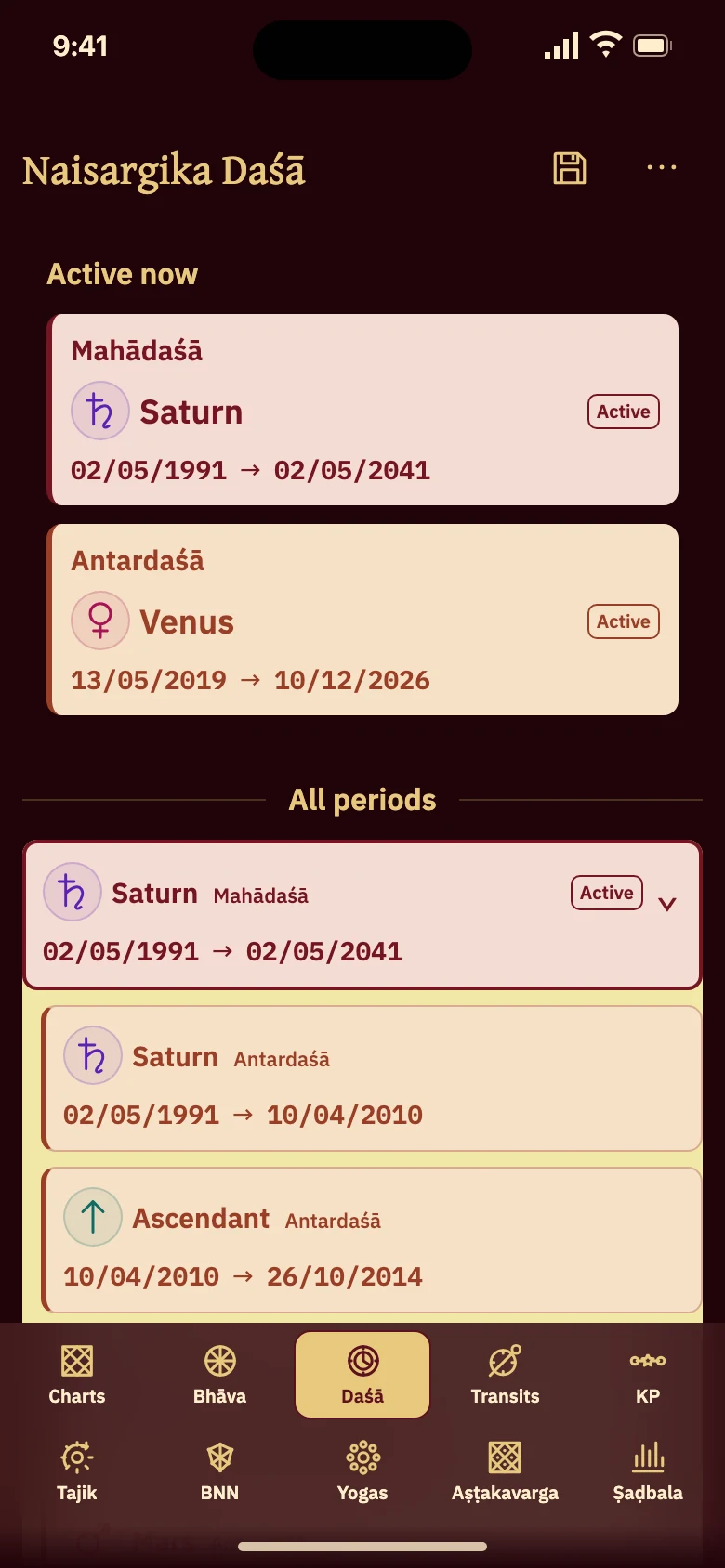
Open Naisargika on a chart you save in Mạghā. Astrology features are free for life. This phone-layout preview, also used on desktop, selects the real system on Nila Raman’s chart at a fixed date.
Open your daśā periods