
Special Pañchāṅga yogas
Mạghā calculates four favourable Pañchāṅga yogas, Sarvārtha Siddhi, Amṛta Siddhi, Guru Puṣya and Ravi, and two cautions, Bhadrā and Pañcaka. Each has dated start and end times. These calendar windows are distinct from yogas in a birth chart.
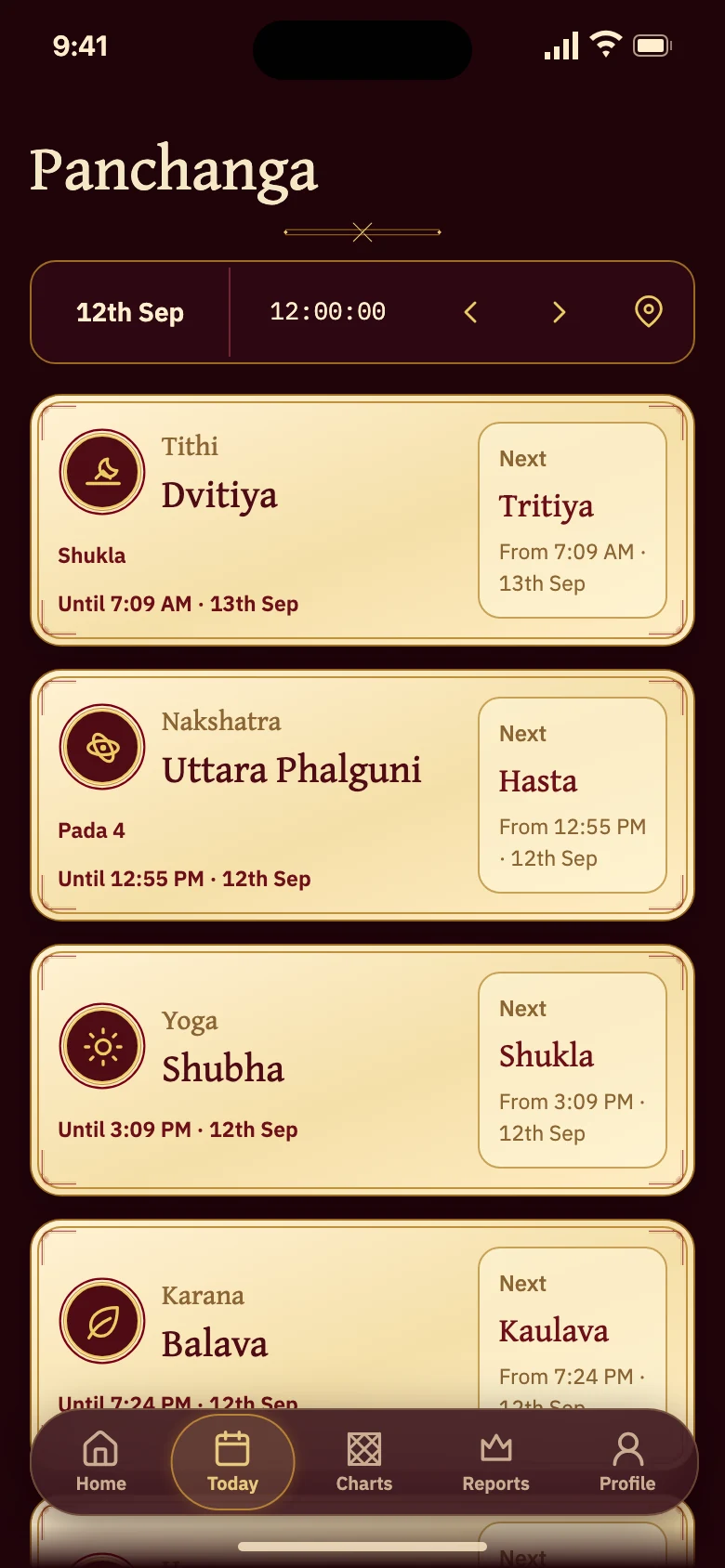
The Moon was in Uttara Phalgunī until 12:55 and Hasta after it, inside Virgo all day, and the half days were Bava, Bālava and Kaulava. No Saturday nakṣatra pair, no Ravi Yoga count, no Viṣṭi and no Pañcaka occurred.
12 September · sunrise13 September · sunrise
- Weekday
- Saturday · Śanivāra
- Nakṣatra
- Uttara Phalgunī · until 12:55:29
- Hasta · after 12:55:29
- Karaṇa
- Bava · until 07:46:52
- Bālava · until 19:23:33
- Kaulava · after 19:23:33
| Check | Result | Reason |
|---|---|---|
| Sarvārtha Siddhi | Not present | Saturday needs Rohiṇī, Svātī or Śravaṇa. |
| Amṛta Siddhi | Not present | Saturday needs Rohiṇī. |
| Guru Puṣya | Not present | Needs Thursday and Puṣya. |
| Ravi Yoga | Not present | Moon 2nd, then 3rd from the Sun's nakṣatra. |
| Bhadrā | Not present | No Viṣṭi karaṇa. |
| Pañcaka | Not present | Moon outside Aquarius and Pisces. |
A day yoga belongs to the calendar, not to a horoscope
Special day yogas combine weekday, solar/lunar nakṣatras and half-tithis for a location and interval. They differ from the Pañchāṅga's 27 longitude-sum yogas and from natal planetary yogas. Names such as Bhadrā and Ravi recur across these systems without sharing the same rule. None of the six day yogas forms in the fixed Bengaluru sample of 12 September 2026, when the Moon moves from Uttara Phalgunī to Hasta.
Weekday–nakṣatra pairs
Sarvārtha Siddhi requires a prescribed weekday–nakṣatra pair. It runs only while both factors hold, ending at the nakṣatra boundary or next sunrise. Published pair tables vary; compare the list with the almanac you follow.
Sarvārtha Siddhi forms when the weekday and the Moon's nakṣatra make one of the pairs in the table Mạghā follows. Sunday pairs with Aśvinī, Puṣya, Uttara Phalgunī, Hasta, Mūla, Uttara Āṣāḍhā and Uttara Bhādrapadā. Monday pairs with Rohiṇī, Mṛgaśirā, Puṣya, Anurādhā and Śravaṇa; Tuesday with Aśvinī, Kṛttikā, Āśleṣā and Uttara Bhādrapadā; Wednesday with Kṛttikā, Rohiṇī, Mṛgaśirā, Hasta and Anurādhā. Thursday takes Aśvinī, Punarvasu, Puṣya, Anurādhā and Revatī, Friday the same with Śravaṇa in place of Puṣya, and Saturday Rohiṇī, Svātī and Śravaṇa.
The yoga lasts while both halves of the pair hold: from sunrise or the Moon's entry into the nakṣatra, whichever is later, until the nakṣatra ends or the next sunrise closes the weekday. Published tables disagree on a few pairs, so compare them with the almanac you follow.
Amṛta Siddhi and Guru Puṣya are the narrowest pairs
Amṛta Siddhi allows one nakṣatra for each weekday: Hasta on Sunday, Mṛgaśirā on Monday, Aśvinī on Tuesday, Anurādhā on Wednesday, Puṣya on Thursday, Revatī on Friday and Rohiṇī on Saturday. B. V. Raman's Muhurtha gives the same list with Śravaṇa for Monday. Each of these pairs is also a Sarvārtha Siddhi pair, so an Amṛta Siddhi day always carries both.
Guru Puṣya is Thursday, the day of Guru (Jupiter), with the Moon in Puṣya, which is also Thursday's Amṛta Siddhi pair. Raman calls Puṣya the most favourable nakṣatra, said to neutralise almost every flaw, yet notes that it is held unfit for marriage. On a Guru Puṣya Thursday, Mạghā therefore finds three favourable yogas at once.
Counting from the Sun's Pūrva Phalgunī as the first, Ravi Yoga needs the Moon in the 4th, 6th, 9th, 10th, 13th or 20th nakṣatra: Citrā, Viśākhā, Mūla, Pūrva Āṣāḍhā, Dhaniṣṭhā or Kṛttikā. The Moon was in Uttara Phalgunī until 12:55 and Hasta after it.
- 01Pūrva Phalgunī
- 02Uttara Phalgunī
- 03Hasta
- 04CitrāRavi Yoga
- 05Svātī
- 06ViśākhāRavi Yoga
- 07Anurādhā
- 08Jyeṣṭhā
- 09MūlaRavi Yoga
- 10Pūrva ĀṣāḍhāRavi Yoga
- 11Uttara Āṣāḍhā
- 12Śravaṇa
- 13DhaniṣṭhāRavi Yoga
- 14Śatabhiṣaj
- 15Pūrva Bhādrapadā
- 16Uttara Bhādrapadā
- 17Revatī
- 18Aśvinī
- 19Bharaṇī
- 20KṛttikāRavi Yoga
- 21Rohiṇī
- 22Mṛgaśirā
- 23Ārdrā
- 24Punarvasu
- 25Puṣya
- 26Āśleṣā
- 27Maghā
Ravi Yoga counts from the Sun's nakṣatra to the Moon's
Ravi Yoga ignores the weekday. Count the nakṣatras from the one the Sun occupies, taking it as the first. When the Moon's nakṣatra is the 4th, 6th, 9th, 10th, 13th or 20th, Ravi Yoga holds for as long as the Moon stays there. The Sun spends about two weeks in each nakṣatra, so the qualifying six stay fixed for days at a time, and the Moon reaches each of them about once a month.
On the sample day the Sun was in Pūrva Phalgunī, which made Citrā, Viśākhā, Mūla, Pūrva Āṣāḍhā, Dhaniṣṭhā and Kṛttikā the Ravi Yoga nakṣatras. The Moon was in Uttara Phalgunī until 12:55 and in Hasta after it, the 2nd and 3rd from the Sun, so the day had no Ravi Yoga. Mạghā takes the Sun's nakṣatra at sunrise.
Bhadrā is the Viṣṭi half of a lunar day
Bhadrā is Viṣṭi, the seventh movable karaṇa, occurring eight times monthly. It occupies the bright fortnight's latter halves of tithis 4/11 and first halves of 8/full moon, and the dark fortnight's latter halves of 3/10 and first halves of 7/14. Each lasts roughly 10–14 hours. Raman advises avoiding it for good work. Some almanacs restrict harm to its earthly residence; Mạghā applies no residence exception and excludes every Viṣṭi interval.
Pañcaka lasts while the Moon crosses Aquarius and Pisces
Nakṣatra Pañcaka spans the last half of Dhaniṣṭhā through Revatī, filling sidereal Aquarius and Pisces for about 4½ days every 27 days. Raman advises against southern journeys, house repairs, gathering fuel/fodder and acquiring beds. This differs from the remainder-based Pañcaka used in some ascendant-selection rules. Mạghā lists every detected interval among avoid windows, but its planner excludes it specifically for Griha Pravesha and Vivaha among its six activities.
Favourable and avoid windows
Bhadrā and Pañcaka appear as avoid windows. Activity time windows uses Sarvartha Siddhi and Ravi Yoga as favourable reasons. Amṛta Siddhi and Guru Puṣya pairs are included under Sarvartha Siddhi.
Note: Mạghā checks the Moon’s quarter only at sunrise and nakṣatra changes. It therefore misses Pañcaka’s start in the second half of Dhaniṣṭhā until Śatabhiṣaj begins or the next sunrise, whichever comes first.
Questions about Sarvārtha Siddhi and the other day yogas
Is there Sarvartha Siddhi Yoga today?
It depends on the weekday, counted from your local sunrise, and on the Moon's nakṣatra, so it changes from day to day: a Saturday needs Rohiṇī, Svātī or Śravaṇa, for example. The yoga lasts only while the pair holds, so it often covers part of a day. For the date and place you choose, Mạghā's activity planner can name it among the reasons for a recommended window.
What is Amrit Siddhi Yoga?
A weekday and nakṣatra pair held to favour new undertakings: Sunday with Hasta, Monday with Mṛgaśirā, Tuesday with Aśvinī, Wednesday with Anurādhā, Thursday with Puṣya, Friday with Revatī and Saturday with Rohiṇī. It is a narrower form of Sarvārtha Siddhi, and some books, B. V. Raman's among them, give Śravaṇa for Monday.
Is Guru Pushya Yoga good for marriage?
Not by the rule B. V. Raman records. Puṣya is praised for almost every undertaking, but it is held to be inauspicious for marriage, and Guru Puṣya is Puṣya on a Thursday. A wedding muhūrta also weighs the couple's charts and many other rules, so no single day yoga settles it.
What should not be done during Panchak?
B. V. Raman lists journeys to the south, house repairs or renovation, gathering fuel and cattle fodder, and acquiring cots and beds. Hindi almanacs also name each Pañcaka after the weekday it begins on, such as Rog Pañcaka; Mạghā lists the stretch without those names.
See where Mạghā marks special yogas on any date
Bengaluru, India · Asia/Kolkata
Check special yogas free, without an account. The still preview's prepared Bengaluru Saturday has the Moon in Uttara Phalgunī and forms none of the six yogas, so none appears.
Check a date in the Pañchāṅga