


Padanāthāṁśa Daśā
Padanāthāṁśa Daśā is an experimental sign-period option in Mạghā. Select Padanathamsa to inspect its dated sequence and subdivisions beside the birth chart. The worked timeline preserves Nila Raman’s chart's saved output.
Nila Raman’s saved Padanāthāṁśa Daśā sequence, frozen on 12 September 2026: Aquarius 8 years, Gemini 4 years, Libra 12 years, Pisces 7 years, Cancer 6 years, Scorpio 8 years, Aries 3 years, Leo 1 years, Sagittarius 10 years, Taurus 5 years, Virgo 1 years, Capricorn 1 years. Saved example only; no independent calculation or accuracy certification.
Birth marker · 14 Oct 1994
- 01Aquarius14 Oct 1994 →
14 Oct 2002 - 02Gemini14 Oct 2002 →
14 Oct 2006 - 03Libra14 Oct 2006 →
14 Oct 2018 - 04Pisces14 Oct 2018 →
13 Oct 2025 - 05Cancer13 Oct 2025 →
14 Oct 2031 - 06Scorpio14 Oct 2031 →
14 Oct 2039 - 07Aries14 Oct 2039 →
14 Oct 2042 - 08Leo14 Oct 2042 →
14 Oct 2043 - 09Sagittarius14 Oct 2043 →
14 Oct 2053 - 10Taurus14 Oct 2053 →
14 Oct 2058 - 11Virgo14 Oct 2058 →
14 Oct 2059 - 12Capricorn14 Oct 2059 →
13 Oct 2060
Widths follow the saved duration in days. Dates are shown in UTC. Gold marks the current period.
Follow the saved sequence from Aquarius
Nila’s saved Padanāthāṁśa timeline opens with Aquarius for eight years, then Gemini for four and Libra for twelve. Pisces follows in October 2018, then Cancer in October 2025. The varying widths in the diagram show that these are unequal periods.
This is a rendering of the existing prepared example, not a fresh calculation or a rule for every birth chart. Start with the broad period, note its dates, and then examine the smaller periods inside it. Keeping the parent interval in view helps you avoid reading an isolated sub-period as the whole story.

Read a period alongside the chart
A sign-period timeline gives a different organising frame from a planetary one. Keep the sign, its place in the birth chart and the surrounding periods together when studying an interval. A date boundary can focus an investigation; it does not guarantee a particular event.
Padanāthāṁśa has specialist interpretations and should be studied with a stated method. The example does not certify agreement with another teacher or program. Comparing it with Chara or Vimśottarī can help you notice which questions belong to the chosen timing method and which belong to the underlying chart.
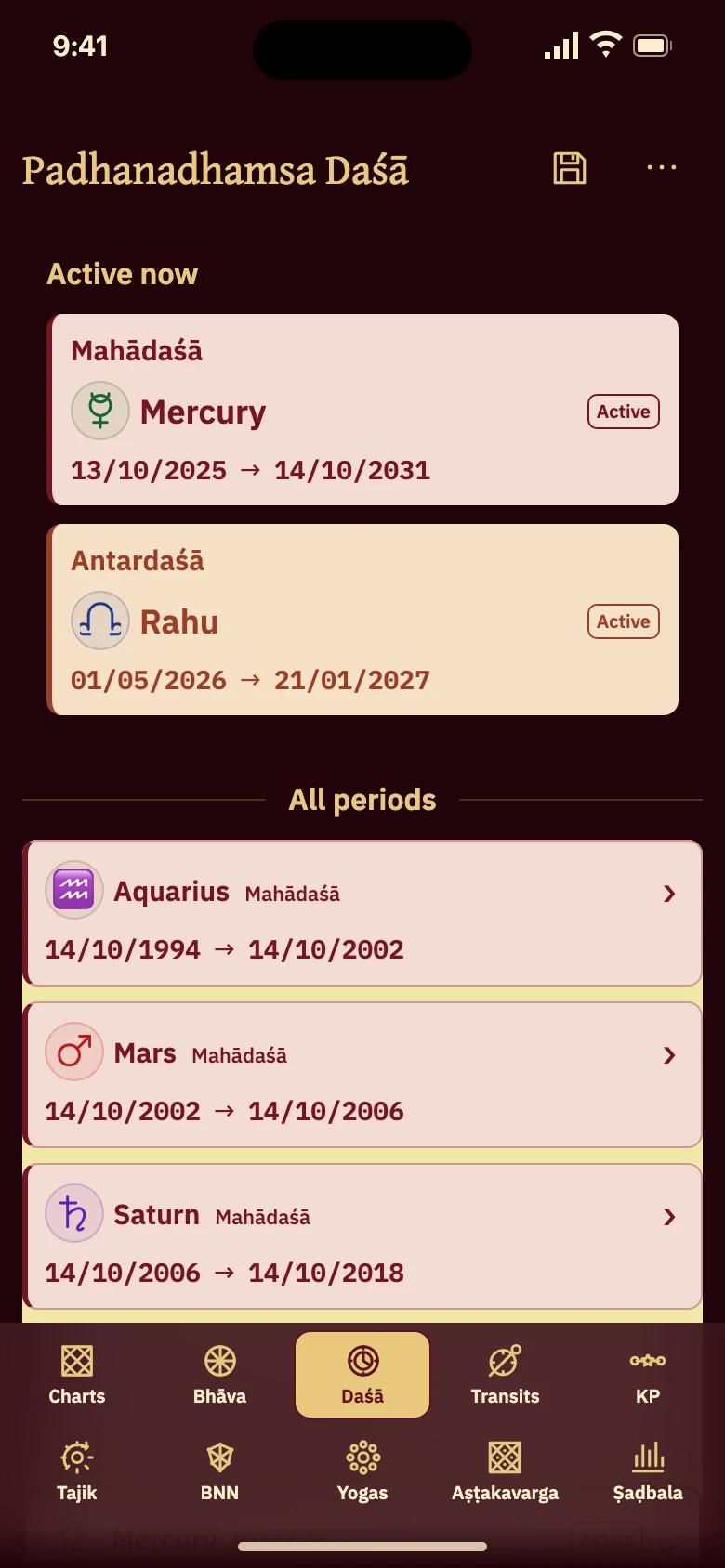
Find Padhanadhamsa in the Daśā options
Open a saved chart, enter Daśā, and use the options menu to choose Experimental, then Padhanadhamsa. The reader shows active periods and a dated period list. Expanding a period lets you inspect the available subdivisions without losing its larger interval.
Note: this is an experimental system. Keep the selected method and period dates with any notes you make. The preview uses Nila’s fixed chart, not your birth details, and its on-screen labels are retained exactly as shown by the app.
Questions about Padanāthāṁśa Daśā
Where is Padanathamsa in Magha?
Open your saved chart’s Daśā options, choose Experimental, then Padhanadhamsa. The app uses that spelling for the system.
Is this a planetary dasha?
It is a Rāśi, or sign-based, daśā. The diagram names the zodiac signs in the saved example rather than the nine planetary lords of Vimśottarī.
Can I enter my birth details in this preview?
No. The preview uses Nila Raman. Sign in and open your own saved chart in Mạghā to explore its period list.
Does the example verify every calculation?
No. It shows a prepared experimental timeline and the real reader. It does not establish agreement with every reference method or guarantee future events.
Explore Padanāthāṁśa Daśā on your chart
This real walkthrough opens Experimental and selects Padhanadhamsa on Nila Raman’s fixed chart. It preserves the app’s displayed labels and periods; visitors cannot enter their own birth details here.
Open your charts